Evidence label: Social Reel is a lead. Court decisions, Country Life in BC, CBC, UBCM and provincial ownership-law records are the anchors. No illegality is alleged.
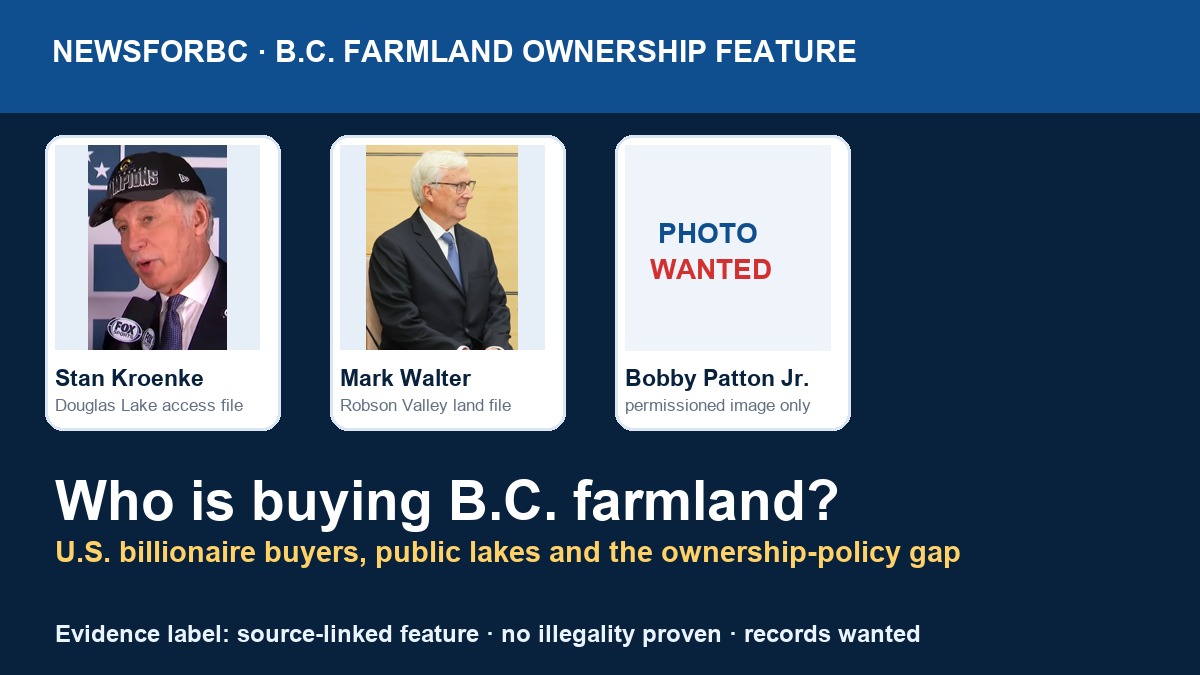
The names are real. The policy question is bigger.
The viral version is simple: American billionaires are buying British Columbia farmland while local farmers and ranchers are priced out. The public record is more complicated — and more useful.
The Instagram Reel posted by Michael Delaney’s Quiet Canines account names three men: Stan Kroenke, the American sports and ranching billionaire behind the Los Angeles Rams and Arsenal; Mark Walter, the investment manager and Los Angeles Dodgers owner; and Robert “Bobby” Patton Jr., a Texas investor connected in B.C. farm reporting to Walter through Fraser River Landholdings Ltd.
The names matter. But the bigger story is not only three wealthy Americans. It is the gap in B.C. law.
British Columbia has the Agricultural Land Reserve, one of Canada’s best-known farmland-preservation systems. But the ALR is mainly a land-use regime. It protects agricultural land from many non-farm uses. It does not, in the ordinary case, stop a foreign billionaire, absentee investor or corporation from buying large blocks of farm or ranch land if the land remains within the permitted use framework.
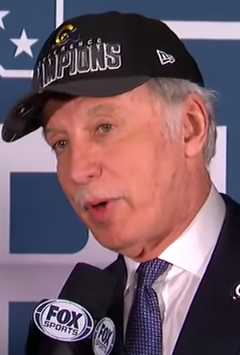
Stan Kroenke
Douglas Lake Cattle Company / public-lake-access litigation.
Photo lead: Wikimedia Commons, CC BY-SA 3.0; see photo ledger.
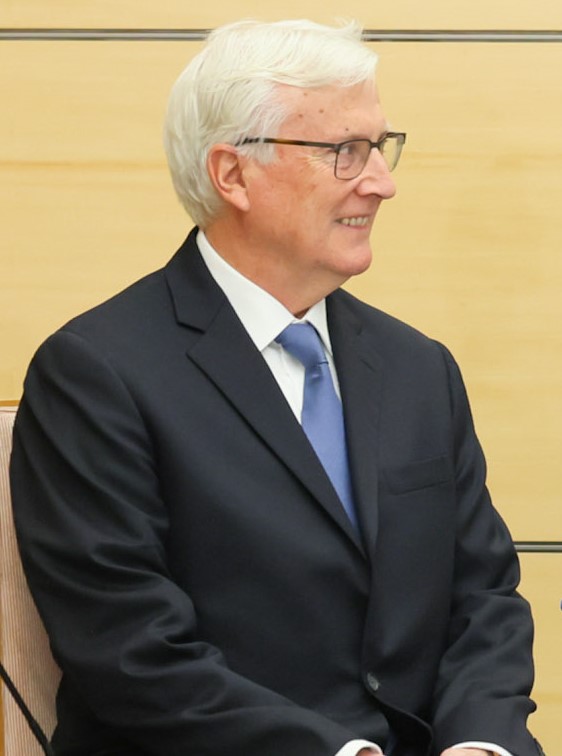
Mark Walter
Dodgers/TWG/Guggenheim profile; Country Life in BC link to Fraser River Landholdings.
Photo lead: Wikimedia Commons; verify attribution terms in photo ledger.
permission required
Robert “Bobby” Patton Jr.
Country Life in BC identifies him as co-director of Fraser River Landholdings Ltd.
No clean reusable public photo found; no scraped/private photo used.
Stan Kroenke: the ranch empire and the lake-access case
Stan Kroenke’s B.C. connection runs through Douglas Lake Cattle Company near Merritt. CBC described the case as a fight involving Canada’s largest private ranch and two Crown-owned lakes, Minnie Lake and Stoney Lake. The lakes were public water. The access routes were the problem.
In 2018, B.C. Supreme Court Justice Joel Groves sided with the Nicola Valley Fish and Game Club, finding public access should be available and sharply criticizing the situation. CBC reported that the trial judge called it “nonsensical” for government to retain rights to a lake if a single landowner could keep the public out.
Then the B.C. Court of Appeal narrowed the road back. In 2021, the appeal court allowed Douglas Lake Cattle Company’s appeal in part. It held that the road at issue was public over its travelled width, but that it did not reach the natural boundaries of Minnie or Stoney Lake. The court also held that the Trespass Act allowed DLCC to prohibit the public from crossing its private land, including land under water, and that the lakes were not navigable on the case made.
That is the legal precision the viral shorthand misses. It was not a court saying the lakes themselves became private. It was a court saying that, without a lawful access route across private land, the public right became practically stranded.
Mark Walter and Bobby Patton Jr.: the Robson Valley file
The Robson Valley story is not a court case. It is a community file.
Country Life in BC reported in April 2026 that Fraser River Landholdings Ltd. had purchased approximately 3,850 acres around Dunster, much of it agricultural land, since the late 2000s. The publication reported that the company is co-directed by Mark Walter and Robert “Bobby” Patton Jr.
Walter’s public profile is not obscure. The Los Angeles Dodgers list him as owner and chairman. The Dodgers profile describes him as chairman and CEO of TWG Global and says his portfolio includes the Dodgers, Lakers, Sparks, Chelsea F.C., the Professional Women’s Hockey League and other sports/media interests. Country Life in BC identifies him as CEO of Guggenheim Partners, a global financial management firm.
Patton is less publicly profiled in the source trail NewsForBC reviewed. Country Life in BC identifies him as a Texas investor with holdings in oil, real estate and ranching. The same article says he and Walter co-direct Fraser River Landholdings Ltd. and Fraser River Partners, an outfitting company connected to hunting and wildlife-viewing opportunities on the properties.
Local critics told Country Life in BC that Dunster is hollowing out. Long-time residents quoted by the paper described reduced population, empty homes, gates and “no trespassing” signs, and a shrinking pathway for new farming families.
But the story also has a response. Vince Lorenz, who handles land purchases for Fraser River Landholdings and is involved with Fraser River Partners, disputed the claim that the American buyers are squeezing locals out. He told Country Life the properties were for sale, that nobody else was putting in offers, that farming activity continues, and that the owners break no laws.
The B.C. difference: land use, not ownership
A Union of B.C. Municipalities resolution from the Regional District of Fraser-Fort George states the issue plainly: B.C. currently has no legislation restricting foreign ownership of agricultural land, and local governments are worried that unrestricted foreign ownership may fuel speculation, compromise food production and put pressure on limited protected agricultural land.
The provincial response in the UBCM record is equally plain. The Ministry of Agriculture and Food said owners of farmland must follow laws and regulations regardless of residency, and that B.C. protects farmland for agricultural use through the Agricultural Land Commission Act and the Agricultural Land Reserve, rather than controlling ownership.
B.C. protects what land can be used for. Saskatchewan and Quebec go further into who can own it.
Saskatchewan says individuals who are not Canadian citizens or permanent residents, and entities totally or partly owned or controlled by non-Canadians, are generally not eligible to own Saskatchewan farmland. Ineligible buyers must apply to the Farm Land Security Board for an exemption to acquire an interest in more than 10 acres.
Quebec’s Act respecting the acquisition of farm land by non-residents says non-residents shall not, directly or indirectly, acquire farm land except with authorization from the commission.
Claim table
| Claim | Evidence label | Finding |
|---|---|---|
| Quiet Canines Reel exists and names Stan Kroenke, Mark Walter and Bobby Patton Jr. | Confirmed social lead | Instagram page metadata/caption shows the Reel, account `quietcanines`, May 31 post, and the three names. |
| Stan Kroenke owns Douglas Lake Cattle Company / Douglas Lake Ranch | Supported by CBC and public reporting | CBC describes Douglas Lake Cattle Company as owned by Stan Kroenke and Canada’s largest private ranch / largest working ranch context. |
| Kroenke “blocked public lakes and won” | Partly true but needs legal precision | B.C. Court of Appeal allowed the Douglas Lake appeal in part. The lakes are public/Crown assets, but the court held the public road did not reach the natural boundaries; the Trespass Act permits DLCC to prohibit crossing its private land. SCC declined leave according to Castanet. |
| Mark Walter and Bobby Patton Jr. are connected to Robson Valley/Dunster land purchases | Supported by Country Life in BC | Country Life in BC reports Fraser River Landholdings Ltd. purchased approx. 3,850 acres around Dunster and is co-directed by Mark Walter and Robert “Bobby” Patton Jr. |
| The purchases are illegal | Not supported | Country Life quotes local representative Vince Lorenz saying the owners break no laws; the legal-policy issue is B.C.’s ownership framework, not a proved illegal purchase. |
| B.C. protects land use more than ownership | Supported by UBCM/provincial response | UBCM resolution records the provincial response that B.C. protects farmland through the ALC Act/ALR rather than controlling ownership. |
| Saskatchewan and Quebec have stronger ownership restrictions | Supported broadly, details vary | Saskatchewan restricts non-Canadian/non-controlled entities unless exempted to acquire over 10 acres; Quebec’s Act says non-residents shall not acquire farm land except with commission authorization. |
| If B.C. Conservatives take power this gets worse | Opinion/prediction | Quiet Canines makes this political forecast; draft should label as commentary, not established fact. |
Why this matters now
The farmland debate is often framed as left versus right, local versus foreign, farmer versus billionaire. Those labels can obscure the real public-policy test.
B.C. can have an Agricultural Land Reserve and still leave rural communities exposed to absentee ownership. B.C. can protect a parcel from subdivision or non-farm use and still watch a village lose families, school enrolment, local volunteers and farm succession. B.C. can say nobody broke the law and still admit the law may not answer the question people are asking.
The Quiet Canines Reel is not proof of every political claim it makes. Its warning about future party policy is commentary. Social-media comments about depopulation or global control are not evidence.
But the underlying issue is real: public water can become practically inaccessible when private land surrounds it; agricultural land can become too expensive for working farmers; and B.C. has not adopted the kind of foreign/corporate farmland-ownership restrictions used in Saskatchewan or Quebec.
Update · August 18, 2026 · Food security and farmland-as-hard-asset context
Does the J.P. Morgan food-security warning add fuel to the farmland story?
Short answer: it adds important context, but it is not proof of motive. The J.P. Morgan analysis, the Neil McCoy-Ward livestream and Canada’s own food-price reports all point in the same broad direction: farmland, fertilizer, water, transport corridors and food logistics are becoming more strategic. That helps explain why productive land can look attractive to very wealthy buyers. But NewsForBC has not found evidence that the named B.C. buyers bought farmland because of this J.P. Morgan report or because of inside knowledge about a future food crisis.
The reader-supplied research brief frames the issue this way: treat the YouTube video as a signal, not a panic forecast. The video says J.P. Morgan warned of a possible food-supply crisis into 2027, driven by fertilizer disruption, Strait of Hormuz risk, El Niño and war-linked energy shocks. NewsForBC checked that against direct public sources.
J.P. Morgan’s public May 21, 2026 analysis (often searched as JPMorgan) says Iran-conflict disruption could hit fertilizer supply, especially nitrogenous fertilizers shipped from the Persian Gulf, raising farm costs and potentially contributing to higher food prices over time. It says a brewing El Niño could add weather stress, shift rainfall and temperature patterns, hurt yields and add food-inflation pressure. It also says over 36% of global urea is imported from the Persian Gulf and that synthetic nitrogen depends on natural gas feedstock.
That matters for farmland because farmland is not only dirt. It is a food-production asset tied to water, fertilizer, rail, trucking, export corridors, local zoning and household food bills. If food inflation and input volatility rise, productive land can become more attractive as a hard asset — especially to buyers who can hold it long-term.
| Signal | What the source says | How it connects to B.C. farmland |
|---|---|---|
| J.P. Morgan | Fertilizer disruption plus El Niño risk can pressure yields and food inflation. | Supports the idea that food-production assets are becoming more strategic. Does not prove B.C. buyer motive. |
| Canada Food Price Report 2026 | Overall food prices forecast to rise 4%–6%; a family of four may spend $17,571.79, up to $994.63 more. | Shows Canadian food affordability pressure is already mainstream, not only a YouTube claim. |
| Statistics Canada | July 2026 food purchased from stores rose 3.1% year over year; grocery inflation outpaced headline CPI for the 18th straight month. | Confirms grocery pressure in current data, even without empty-shelf scarcity. |
| FCC farmland values | Canadian cultivated farmland values rose 9.3% on average in 2025; B.C. averaged -1.7%. | Canada-wide land inflation remains real; B.C.’s 2025 average dip does not erase the strategic value of scarce ALR land. |
| Land Report | Bill Gates/Cascade-linked holdings are listed at 275,000 total acres; almost 250,000 acres of productive farm ground across 17 states. | Shows the U.S. billionaire-farmland theme is real, but it is U.S. context, not proof about B.C. purchases. |
| FAO / USDA | FAO July 2026 food index rose 0.6% month over month; USDA August 2026 WASDE still showed projected world wheat ending stocks around 273.25 million tonnes. | Mixed signal: price pressure exists, but global grain stock data does not support a simple “no food” claim for Canada. |
What about Bill Gates buying U.S. farmland?
The Gates farmland story is real as a U.S. ownership context. The Land Report lists Gates at 275,000 total acres and says he is America’s largest private farmland owner, with almost 250,000 acres of highly productive farm ground spread over 17 states. It also says much of the acreage was bought in large tranches, including farmland assets previously owned by the Canada Pension Plan Investment Board and the 100 Circles acreage in eastern Washington.
That does not mean Gates is buying B.C. farmland, nor does it prove that American buyers in B.C. are acting from a coordinated food-crisis plan. But it supports the broader reader question: billionaires and institutional capital have already treated farmland as an investable asset class in the United States. B.C. readers are entitled to ask whether B.C.’s Agricultural Land Reserve needs an ownership-transparency and food-security lens, not only a land-use lens.
What this does — and does not — prove
- Proven: J.P. Morgan publicly warns that fertilizer disruption and El Niño risk can add food-inflation and crop-output pressure.
- Proven: Canadian food-price forecasters expect 2026 food prices to rise 4%–6%.
- Proven: Canadian grocery inflation is still outpacing headline inflation in current StatCan data.
- Proven: billionaire farmland ownership is a real U.S. phenomenon, with Gates/Cascade-linked holdings widely tracked by The Land Report.
- Not proven: that the named B.C. buyers bought because of J.P. Morgan, a food-crisis forecast, Bill Gates, or inside knowledge.
- Best B.C. angle: farmland ownership transparency, food security, local farm economics, ALR policy and rural logistics resilience.
Records and indicators NewsForBC will watch
- FCC Farmland Values and B.C. regional land-price changes.
- Statistics Canada food-from-stores CPI and B.C. food basket items.
- Canada’s Food Price Report 2026 category forecasts.
- FAO Food Price Index and USDA WASDE wheat/cereal stocks.
- B.C. drought levels, Kettle/Boundary basin water restrictions and rancher hay costs.
- Port of Vancouver, CN/CPKC and Highway 3 disruptions that can affect food movement into the Interior.
- Any future public record tying a specific B.C. farmland buyer to a food-security, water-security or commodity-inflation investment thesis.
Added sources: update source note · OCR’d PDF brief · YouTube transcript · J.P. Morgan public analysis capture · Canada Food Price Report capture · StatCan CPI capture · Land Report Gates capture.
Records wanted
- How much ALR land is owned by foreign-controlled corporations?
- How much productive farmland sits idle or lightly used?
- How many parcels are being consolidated by absentee owners?
- Should B.C. create an ownership registry for agricultural land?
- Should public-access easements be required when public lakes or rivers are surrounded by private holdings?