NewsForBC / Energy & Industry / Analysis · 2026-10-02
LNG Canada’s Chinese steel decision tests the promise—and the limits—of Buy Canadian
A $33-billion expansion in Kitimat has reopened a difficult question for Ottawa and B.C.: how much of a nationally important project will Canadian industry actually get to build?
LNG Canada plans to return to a Chinese state-owned supplier for major components of its Phase 2 expansion, according to CBC reporting published October 2. The consortium says Canada lacks the fabrication facilities needed for enormous, complex plant modules. Canadian steel fabricators dispute that assessment and want access to the specifications before their capabilities are ruled out.
That disagreement is the centre of the story. It is more consequential than a simple choice between supporting an LNG project and supporting Canadian workers—and it cannot be resolved by repeating either side’s assertion.
The sourcing decision also exposes a gap between Prime Minister Mark Carney’s broad promise to build major projects with Canadian materials and the narrower reach of federal procurement rules. A private consortium deciding what to buy is not the same as Ottawa awarding a public construction contract.
What is being bought—and what $33 billion does not mean
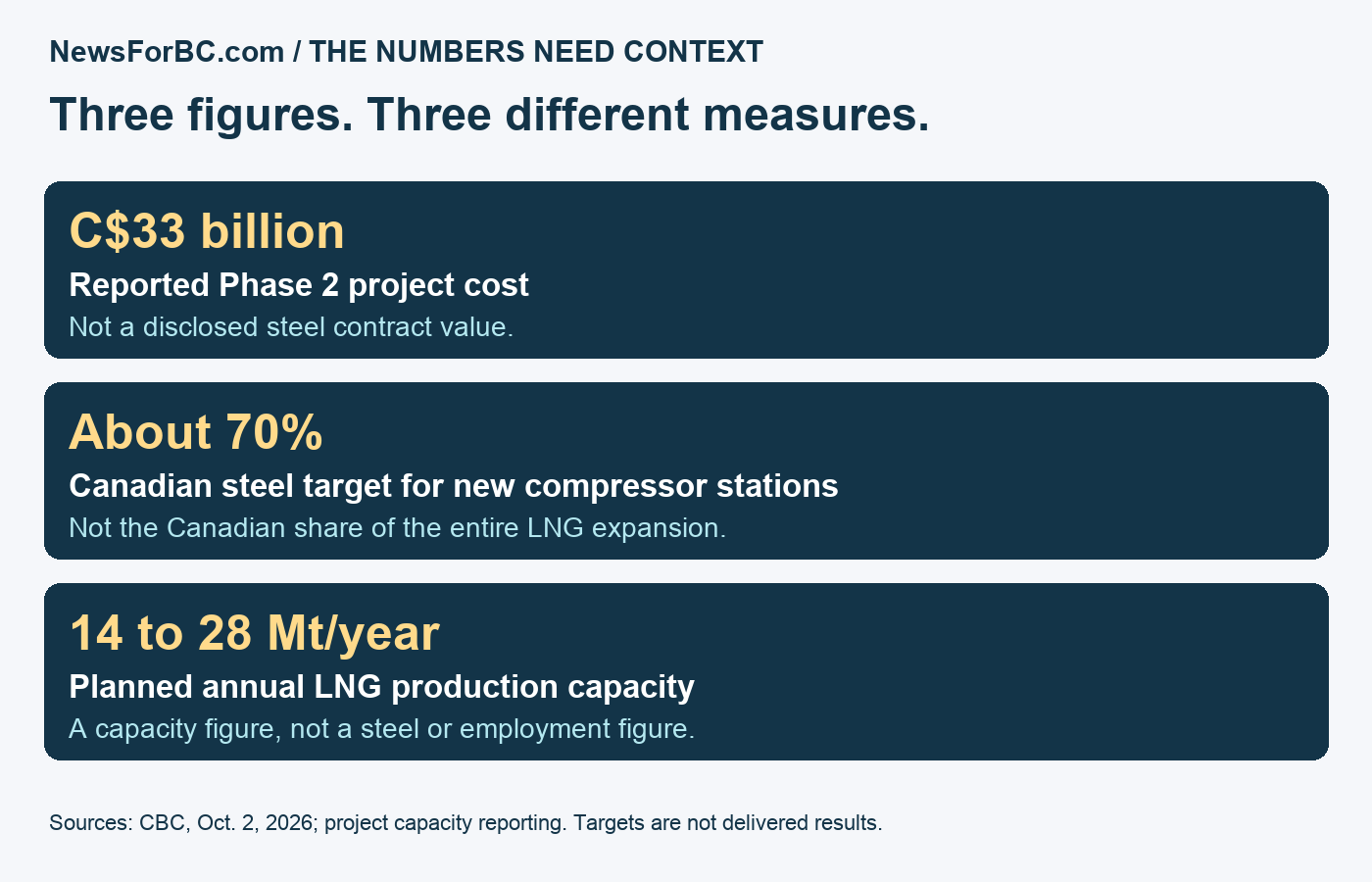
CBC reports that LNG Canada will buy additional components from China Offshore Oil Engineering Co. Ltd., or COOEC, which supplied modules for the project’s first phase. The planned additions are two LNG processing trains, taking the facility from two trains to four and increasing planned annual capacity from 14 million to 28 million tonnes.
A processing “train” is an industrial production unit, not a railway train. Large prefabricated modules combine structural steel with equipment, piping and other systems before shipment and installation. The supply-chain question is therefore wider than where a tonne of raw steel is produced: it includes engineering, fabrication, assembly, transport and work completed at the Kitimat site.
The C$33-billion figure is the reported cost of the Phase 2 expansion. It is not a disclosed C$33-billion Chinese steel order. The sources reviewed do not establish the value of the COOEC supply package or what percentage of the complete expansion budget it represents.
The Prime Minister’s Office confirmed the final investment decision on September 29 and described C$33 billion as private-sector investment. It also confirmed planned capacity of 28 million tonnes a year. CBC reports an anticipated completion period in the early 2030s. Investment approval and an anticipated schedule are not proof that every purchase has been placed or every construction milestone reached.
The capacity claim is contested
LNG Canada spokesperson Paul Hagel told CBC that only five fabrication yards worldwide have the necessary combination of space, capacity, quality systems and marine access for these modules, including COOEC in China. The company says no Canadian yard can manufacture and deliver the additional modules required.
That is a specific commercial and engineering claim—not a finding that Canada cannot make steel.
CBC also obtained a materially different view from the Canadian Institute of Steel Construction. CISC said Canadian fabricators could deliver a substantial portion of the work, including modules, and wanted discussions about the specifications, scope and schedule. According to CBC, the institute said LNG Canada had not reached out to its members.
Neither assertion should be treated as the final technical assessment without the procurement record. The useful questions are whether Canadian suppliers were invited to qualify; how large and integrated the modules must be; whether packages can be divided without unacceptable risk; and which capacity, cost or schedule requirements excluded domestic options.
CISC’s confidence is an industry position, not a completed winning bid. LNG Canada’s explanation is the purchaser’s position, not an independently published comparison of all Canadian alternatives.
Why the route to Kitimat matters
The company told CBC that modules of this scale cannot travel to Kitimat by road and need tidewater fabrication and marine delivery. Its existing module offloading facility provides the receiving point at the site.
CBC reported that CISC challenges the conclusion that Canadian suppliers could not deliver, pointing to rail connections to West Coast ports and onward shipment by sea. That possibility still needs to be tested against actual dimensions, weights, clearances, port equipment, assembly plans and scheduling.
A national industrial strategy cannot create a suitable yard merely by declaring a preference. Equally, “no capacity” is not a sufficient public explanation if a different package design, partnership or investment could enable domestic participation. The distinction is between what is immediately available for this procurement and what governments and industry could realistically build for a longer pipeline of projects.
Buy Canadian: political promise versus purchasing rule
When LNG Canada’s expansion was referred to the Major Projects Office in September 2025, Carney linked major projects to the government’s Buy Canadian agenda. Asked this week about Canadian or Chinese steel for the expansion, he deferred the decision to the proponents while saying there would be opportunities for Canadian suppliers, CBC reported.
The published Policy on Prioritizing Canadian Materials in Federal Procurements helps explain the distinction. Effective December 16, 2025, it applies to specified defence-goods and construction procurements by or on behalf of federal departments and agencies valued at C$25 million or more, subject to its provisions and material-specific thresholds. It does not turn every private project endorsed by Ottawa into a federal purchasing contract.
For steel within its scope, the policy’s Canadian-content definition concerns steel melted and poured in Canada and finished products made from it. That is more precise than simply placing an order with a Canadian distributor.
This is not evidence that LNG Canada has breached that policy. It is evidence that the public promise was broader than the procurement mechanism described in the published rule.
If governments want private megaprojects to meet particular domestic-content obligations, those conditions need to be identified in the relevant funding, procurement or other enforceable agreements. NewsForBC has not reviewed a project-specific agreement imposing a blanket Canadian-steel requirement on this expansion. Political endorsement alone does not establish such an obligation.
The 70 per cent figure has a narrow denominator
There is a Canadian-steel target in the reporting—but it must not be overstated.
LNG Canada told CBC that new compressor stations associated with expanding the Coastal GasLink pipeline network would target almost 15,000 tonnes from Canadian suppliers or mills, approximately 70 per cent of the steel required for that work.
That is a target for the new compressor-station work, not a claim that 70 per cent of the entire LNG expansion will be Canadian steel. It is also a target rather than a final account of delivered materials.
A credible benefits report should distinguish supplier location, where steel was made, contract value, fabrication hours, installation hours and permanent operating employment. Each measures something different. Announcing a Canadian spending total does not, by itself, answer how much manufacturing took place in Canada.
Tariffs are another separate question
CBC reports that earlier anti-dumping and countervailing measures affecting fabricated industrial steel expired and that LNG Canada says its planned Chinese components currently attract no tariffs. The CBSA’s historical fabricated-steel page records an expiry notice for the relevant finding in May 2022.
That history should not be confused with a statement that all Chinese steel enters Canada tariff-free. Product definitions, tariff classifications, exclusions and the particular measures in effect determine treatment. The word “steel” is not enough to establish a duty rate.
Nor does the absence of a tariff prove that Canada has no relevant capability. Tariff coverage and the commercial suitability of a supplier are different questions. NewsForBC has not reviewed the Phase 2 customs classifications or issued a shipment-specific tariff assessment.
Who chooses the suppliers?
LNG Canada is a consortium, not a government-owned purchasing agency. Its partners are Shell at 40 per cent, PETRONAS at 25 per cent, PetroChina at 15 per cent, Mitsubishi at 15 per cent and KOGAS at five per cent, according to the project’s ownership information and CBC’s report.
PetroChina’s ownership interest is not the same thing as COOEC’s supplier role. Nor do those relationships establish that Carney personally selected the fabricator. The political accountability question concerns the promises, policies and conditions governments attach to projects they promote—not an unsupported claim that a prime minister signed the steel purchase order.
For B.C., the expansion can bring construction, logistics, contracting and operating opportunities even if substantial fabrication occurs overseas. Those benefits do not make the location of manufacturing irrelevant. Both the work gained in Canada and the work placed abroad need to be measured rather than traded as competing slogans.
B.C. benefits need their own accounting
The Prime Minister’s Office projects more than 4,000 direct jobs during the construction phase. CBC’s announcement report used the different formulation ‘up to 4,000’ at peak construction in Kitimat. Those descriptions should not be silently merged into a single precise count. Neither is a measured employment result, a promise of that many permanent positions, or a count of Canadian steelmaking jobs. Neither can establish manufacturing work displaced abroad without a separate comparison.
The official announcement also describes an option for MNT Investments LP, representing the Gitga’at, Gitxaała, Haisla, Kitselas and Kitsumkalum Nations, to invest up to C$1 billion for a majority stake in the new Phase 2 storage tank through a sale-leaseback structure. An investment option is not an already completed acquisition, and the tank interest is not a majority stake in all of LNG Canada. It is nevertheless a distinct potential route to local long-term revenue that a steel-only discussion would miss.
LNG Canada identifies the facility as being in the traditional territory of the Haisla Nation and says its first cargo was loaded in June 2025. Local and Indigenous participation therefore belongs at the centre of the benefits discussion, not as an afterthought to a dispute between Ottawa and manufacturers.
CBC’s September 29 reporting also carried former Haisla chief councillor and current MP Ellis Ross’s argument that Indigenous leaders deserved credit for decades of work advancing LNG. His criticism of politicians taking credit is a political assessment; the underlying question for this expansion is concrete: which communities and businesses will receive contracts, training and durable employment, and how will those outcomes be disclosed?
An imported module is not evidence that the entire project produces no Canadian benefit. A large construction forecast is not evidence that every feasible domestic manufacturing opportunity was pursued. A useful public ledger must be able to show both.
The records that would settle the debate
The next useful disclosures are practical:
- Procurement scope: the size and value of the COOEC package, what it includes and which parts remain open to Canadian suppliers.
- Capability assessment: the technical criteria, domestic supplier outreach, alternative packaging options and reasons for rejecting them.
- Benefits commitments: Canadian and B.C. spending, manufacturing content, Indigenous procurement and employment targets, with methods that avoid counting the same benefit twice.
- Delivery evidence: awarded contracts and actual outcomes compared with promises, including the compressor-station steel target.
- Public conditions: any domestic-content requirements attached to government support, alongside exceptions and compliance reporting.
The Facebook post that prompted this feature presents the sourcing decision as a political failure. The underlying CBC report establishes a real dispute, but it also contains the company’s capacity explanation and the Canadian industry’s challenge. Those competing positions belong in the same story.
The test is not whether a project carries a Canadian name. It is whether the public can see which opportunities were available, which choices were made and which Canadian benefits were actually delivered.
Reporting note: This is an original NewsForBC analysis of published reporting and public documents, not a report based on new interviews. Statements attributed to LNG Canada, CISC and federal officials through CBC were obtained by CBC, not by NewsForBC. No outreach was conducted for this article. Project costs, targets and schedules are identified as such; undisclosed contract details remain unknown.
Sources and reporting method
- Prime Minister’s Office, September 29, 2026 — LNG Canada Phase 2 final investment decision
- CBC, October 2, 2026 — LNG Canada to use Chinese steel on $33B expansion project in Kitimat, B.C.
- CanadaBuys — Policy on Prioritizing Canadian Materials in Federal Procurements
- CBSA — Fabricated Industrial Steel Components
- LNG Canada — About the project
- CBC, September 29, 2026 — LNG Canada to move forward with Phase 2 expansion
- Michelle Ferreri Facebook post — the source lead, not independent proof