Kamloops, five years later: certainty first, answers still pending
Published 2026-10-06 · Public-record research through October 6, 2026
NewsForBC | Accountability feature & analysis | Research edition, October 6, 2026
Millions in documented funding. A major accounting correction. An unresolved burial investigation. The strongest case for scrutiny is in the records—not in claims that every radar target has been proved to be a pipe.
Accountability feature & analysis. This feature examines a specific investigation, its public claims and its funding. It does not dispute the documented deaths and harms of residential schools. Existing public responses are included; no fresh interviews or requests for comment were conducted.
The question that five years have not answered
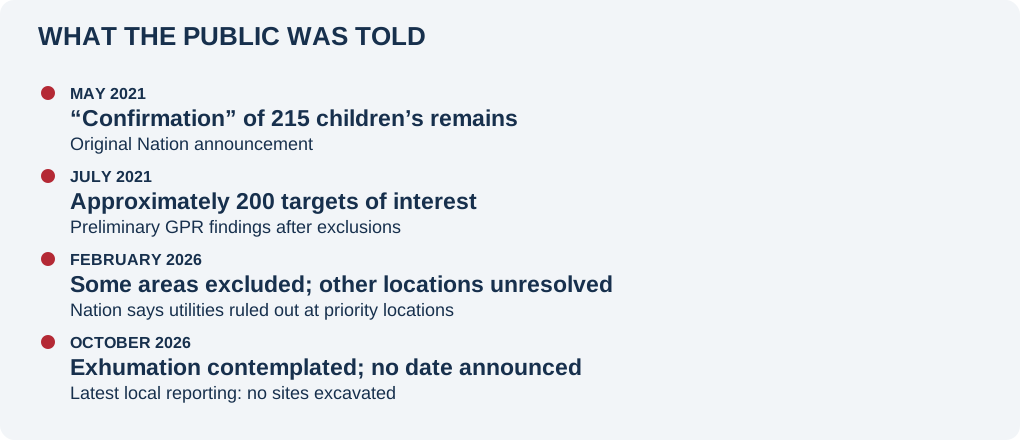
On May 27, 2021, Tk’emlúps te Secwépemc announced “the confirmation of the remains of 215 children” at the former Kamloops Indian Residential School. It also called the findings preliminary. Those two descriptions sat uneasily together from the beginning: a preliminary radar interpretation is not physical confirmation of children's remains. [2]
More than five years later, the distinction is still central. In reporting published October 5, 2026, Castanet said none of the potential burial sites had been excavated. Chief Rosanne Casimir said exhumation was part of the process but offered no date. She described the work as delicate and painstaking and said it could not be rushed. Another report on the investigation was being prepared. [3]
The strongest criticism is not that careful archaeology is ridiculous. It is that the public was given certainty before the evidence justified certainty, while the timetable for resolving the central claim remains open-ended.
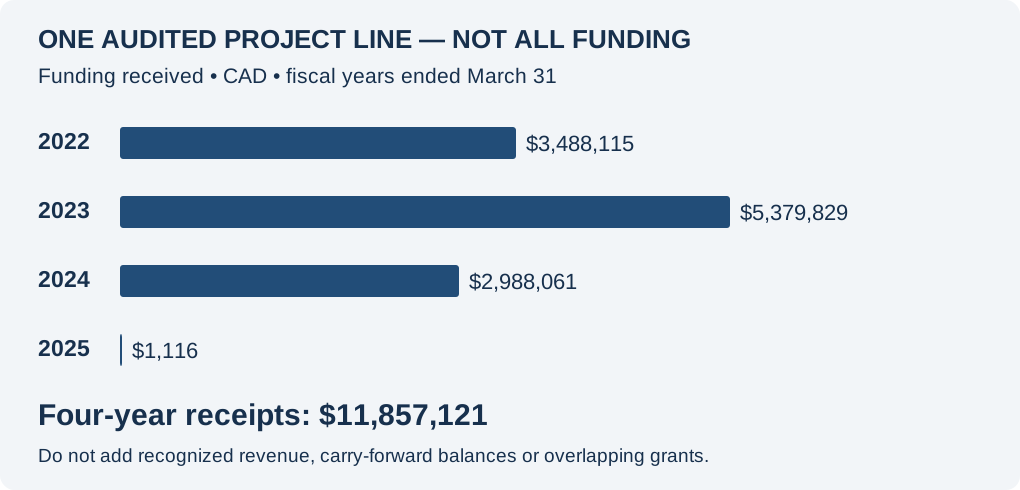
The financial stakes are substantial. NewsForBC's review of four annual financial statements found $11,857,121 in the “Funding Received” column of the deferred-revenue line labelled “Le Estecewey/The Missing,” for fiscal years ending March 2022 through March 2025. That is a specific accounting subtotal—not a claim that all of it bought excavation, that it represents every project receipt, or that researchers personally received it. [4][5][6][7]
A separate note in the 2025 statements disclosed that $5,002,500 received from the First Nations Health Authority for the Healing House in fiscal 2024 had been omitted from the original accounts. The comparative figures were corrected. The note says the remaining money was held in a separate bank account under the Nation. That is a serious, documented accounting error; it is not evidence that the money disappeared. [7]
There is enough here for a demanding accountability story without claiming a proven hoax, inventing personal enrichment, or denying the school's documented history.
What was actually announced—and what changed
The original announcement did not merely report an interesting patch of disturbed soil. It identified children's remains, gave a number, and included a statement that some children were as young as three. Ground-penetrating radar cannot, by itself, establish a buried person's age or identity. Those elements required evidence beyond a radar image. [2][8]
By July 15, 2021, the public presentation was more qualified. Researcher Sarah Beaulieu described approximately 200 targets of interest, after reviewing information about previous excavations and other disturbances. Her university called them probable unmarked graves; the technical material described a preliminary survey. [9][8][10]
That revision matters. A number that became a national symbol was not a completed count of recovered bodies. Yet the original language continued to echo in official communications. A March 2023 federal funding announcement still referred to the “discovery of 215 unmarked graves.” That was government wording—not new archaeological verification. [11]
By February 2026, the Nation's update said some areas had been ruled out as burials, while other possible burial locations could not confidently be ruled out. [12] The Nation's July 15, 2021 release had already said that definitive results require forensic investigation with excavation. [13]
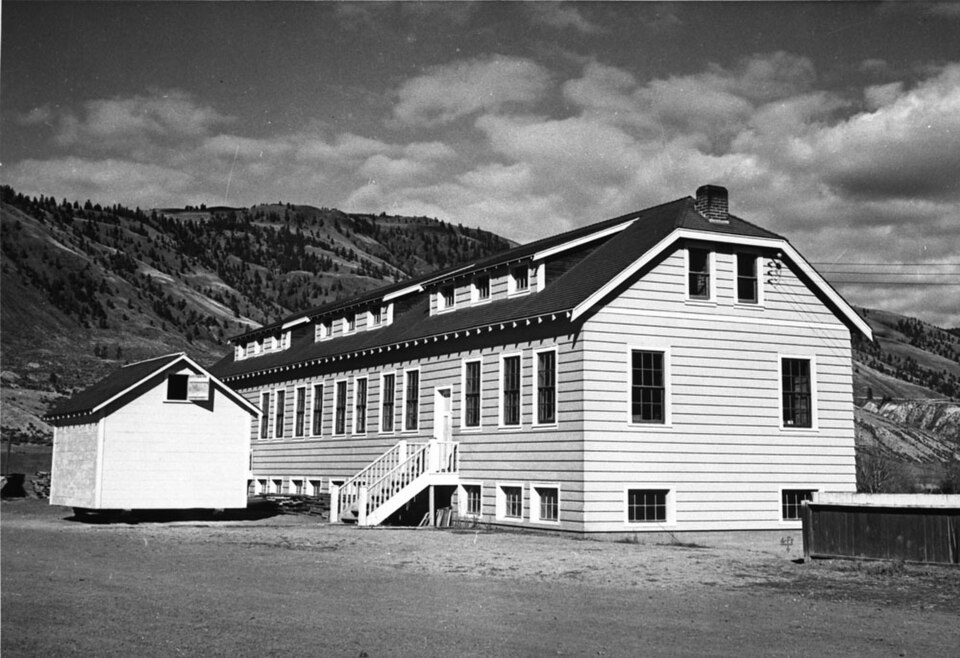
The school itself is not an invented tragedy. The National Centre for Truth and Reconciliation maintains a named memorial register for children associated with Kamloops, which operated from 1890 to 1978. Documented student deaths and the specific claim of additional, unidentified orchard burials are different questions. Evidence for the first cannot automatically establish the second; uncertainty about the second cannot erase the first. [14]
The septic system: a real archival lead, not a completed diagnosis
The Facebook post supplied for this feature alleges that the supposed graves sit above a historic septic field and that 15 were old archaeological test pits. The underlying infrastructure is real. The inference that it explains every remaining target is not established. [15]
A January 1926 engineering report preserved through the NCTR describes the school's sewage-disposal system. Crucially, the report dates the construction work to October–December 1924. That corrects commentary which describes the system as installed in 1926: 1926 is the report date. The records describe open-jointed land tiles, disposal beds and a change from a planned shallow installation to tiles laid 3 feet 6 inches below the surface. [16]
These are relevant alternative sources of underground disturbance. They are not, on their own, a georeferenced match between each radar anomaly and a surviving pipe. Nor should roughly similar depths be described as identical. Historic ground levels, later disturbance and the precision of both surveys matter.
Archival document: Read the January 1926 sewage-disposal records. The records are not an independently registered overlay of the 2021 radar targets. The third-party scan is linked rather than reproduced because reproduction rights have not been confirmed.
National Post writer Tristin Hopper's May 2026 opinion article assembled specialist comments explaining why pipes, rocks, roots and other disturbances can resemble burial-related signals. The experts included forensic anthropologist Michael Billinger, forensic geoscientist Jamie Pringle and radar specialist Jan Francke. Their examples make the alternative explanation technically plausible; the article does not establish that they independently excavated the Kamloops targets or reprocessed its complete dataset. [18]
There is also a response that an honest feature cannot omit. The Nation's February 17 update says investigators ruled out utility lines and clay tiles in the priority locations where different search methods overlapped. It reports work involving GPR, LiDAR and three independently searching historic-human-remains detection dog teams. [12]
That statement deserves examination, not deletion. The release is not a full technical report: it does not provide the raw survey grids, a target-by-target reconciliation or the complete evidence needed for an outside reviewer to audit the exclusion. It also does not establish that every original target has been conclusively explained.
The next useful question is therefore not “Are pipes possible?” It is: Which targets remain, what evidence excludes the pipes at each location, and who independently checked that interpretation?
The “15 test pits” claim needs similar discipline. Contemporary accounts support a reduction from 215 to approximately 200 after earlier excavation and disturbance information was considered. That is not automatically proof that 15 discarded targets each corresponded to one known shovel-test pit. The surviving records support a correction for prior disturbances; the one-to-one claim remains unverified. [10][18]
Who did the work—and what their experience really shows
Sarah Beaulieu: relevant credentials, unresolved site-specific results
Beaulieu conducted the original GPR work. A Nation/museum information pamphlet says the Language and Culture Department collaborated with Natural Resources to contract her. UFV's contemporaneous account identifies her as the collaborating researcher presenting the July 2021 findings. [19][9]
Her academic qualifications are substantive. Her Simon Fraser University doctoral thesis identifies an MA from SFU in 2015 and a 2019 PhD in the Department of Archaeology. The doctorate was defended in July 2019 and concerned the Morrissey First World War internment camp. Her earlier research involved cemetery radar work; the doctoral research included mapping, remote sensing and physical excavation. The Canadian Museum of History independently describes her Morrissey fieldwork. [20][21]
It would be false to imply she had no archaeology training, that “Doctor of Philosophy” meant she studied philosophy rather than archaeology, or that her entire background consisted of looking at artifacts others had excavated.
UFV says she trained at Canadian Forces Base Borden and received certification in 2016. Her 2019 thesis, written before the Kamloops controversy, acknowledges funding for equipment and remote-sensing training at that location. However, the material reviewed does not reproduce the certificate or establish the issuing body, course duration or assessment standard. Training at a military base is not necessarily professional accreditation by the Canadian Armed Forces. [22][20]
The university also describes cemetery work and liaison with the RCMP concerning clandestine graves. That establishes what UFV says about her experience, not a published, independently verified case-by-case success rate. An undated current biography cannot establish that every activity preceded May 2021. [22]
The distinction is straightforward: relevant qualifications make someone a credible investigator; they do not validate every interpretation the investigator makes. Her university's 2022 tenure-track appointment is also not a credential that can be backdated to the original survey. [23]
Leadership is not the same as technical interpretation
Chief Rosanne Casimir has led public communications and political oversight. The Nation's biography lists business-administration education and leadership and negotiation training. She is not identified as the radar operator. Her accountability concerns governance, funding, consent and the accuracy of public statements—not an expectation that a chief personally hold a forensic degree. [24]
The Nation/museum pamphlet identifies Jeanette Jules as Manager of Community Engagement & Investigations, Diena Jules as Language and Culture Manager, and Fred Seymour as Manager of Capital Infrastructure & Political Liaison. Those are distinct responsibilities, not interchangeable scientific credentials. It also describes the family-advisory structure and its role in recommendations to Chief and Council. [19]
The 2026 update refers to independent specialists and certified dog teams without supplying a complete named technical roster or the underlying certification records. That leaves a legitimate disclosure question: who acquired the data, who interpreted it, who reviewed the conclusions, and what comparable work had each completed? [12]
No verified personal fee total for Beaulieu, or complete contractor-by-contractor payment schedule, was obtained. A grant to the Nation is not evidence that a particular researcher pocketed that grant.
Follow the money—without counting it twice
All amounts below are Canadian dollars. The financial cutoff is important: the latest audited statements reviewed end March 31, 2025, not October 2026.
The clearest primary-source series is the deferred-revenue line named “Le Estecewey/The Missing.” The statements place it under ISC contributions. They do not provide a complete agreement-by-agreement mapping to the federal Missing Children Support Fund, so the two scopes should not be silently treated as identical. [4][5][6][7]
| Fiscal year ended March 31 | Funding received in this line | Revenue recognized from this line | Closing deferred balance |
|---|---|---|---|
| 2022 | $3,488,115 | $371,995 | $3,116,120 |
| 2023 | $5,379,829 | $3,488,115 | $5,007,834 |
| 2024 | $2,988,061 | $5,705,727 | $2,290,168 |
| 2025 | $1,116 | $2,290,168 | $1,116 |
| Four-year column subtotal | $11,857,121 | $11,856,005 | Not additive across years |
The starting deferred balance for this line in the 2022 statement is zero. Each year's closing balance carries into the next year's opening balance. Adding those balances to receipts would count the same money repeatedly.
“Revenue recognized” is an accounting classification, not a list of cheques to scientists or a verified excavation-spending total. Equally, a deferred balance is not proof that cash was stolen, secretly accumulated or improperly retained. Readers need the corresponding eligible-cost schedules and agreement terms to assess performance.
This accounting trail also means “there is no public accounting” would be wrong. There is public accounting. What remains missing from the material obtained is the detailed bridge between that accounting, each funding agreement, individual contractors, actual activities and independently checkable outcomes.
Why the familiar $12.1 million headline needs a reconciliation
Reporting has repeatedly circulated a $12.1 million figure. This review did not reconcile that number to an original payment schedule. It should not be relabelled as a verified amount spent digging for bodies or added to the audited series above. Some accounts use different program and museum-related scopes. [25]
The Globe and Mail's May 2026 investigation, based on access-to-information records, reported a $9,541,302 two-year request in July 2021, $7,386,566 subsequently approved, and a $9.5 million federal Fund commitment by March 2026, confirmed by Minister Rebecca Alty's office. These are stages or scopes of funding—not three separate pots to add together. NewsForBC read the Globe's report, not its underlying unredacted agreements. [10]
There is a further complication for demands that all money be repaid because no excavation occurred: the Globe reported that excavation was not mandatory under the funding terms. Eligible activities were broader, and the department said the Nation was meeting accountability requirements. That is the government's reported position, not an independent value-for-money audit. [10]
The stronger challenge is to the design and oversight of the funding: what measurable work was promised, completed and reviewed? Compliance with broad grant terms and resolution of the original burial claim are not necessarily the same thing.
The wider funding secured around the response
The 2021 announcement was followed by funding for healing, buildings, commemoration and related work. Some official announcements explicitly connect this support to the community response. That is a documented political and funding consequence—not proof that any leader fabricated evidence to obtain it.
The joint federal/FNHA announcement of March 23, 2023 identifies four distinct items: [11]
- $12.5 million committed federally toward construction of a Healing House, following a commitment during Justin Trudeau's October 2021 visit.
- $2.5 million already provided by FNHA for intergenerational and residential-school impacts.
- An additional $1.3 million provided by FNHA for engagement and planning.
- Up to $1.5 million committed for a feasibility assessment of structural renovations and design upgrades to the former school.
These combine commitments, money described as provided, and a ceiling. They are not a verified cash-received subtotal. The later $5,002,500 Healing House receipt must not be added as wholly new money without tracing the transfer route and any overlap.
The $5 million omission deserves a specific answer
Note 23 of the 2025 financial statements says Healing House transactions were excluded from the previous year's accounts. It reports $5,002,500 received in fiscal 2024, only $19,595 in preliminary capital expenditures at that point, and money held in a separate bank account. The comparative accounts were restated. The 2025 deferred-revenue schedule shows a $4,639,559 closing Healing House balance after recognizing revenue during that year. [7]
That correction raises concrete governance questions: how was the separate bank account missed in financial reporting, who reconciled it, and what controls changed? It does not establish theft, and the fiscal-2024 statement that construction had not begun should not be presented as the project's current October 2026 status.
The 2024 and 2025 statements also carry qualified audit opinions, with specified issues involving asset-retirement obligations and business-enterprise accounting or evidence. Those qualifications should not be misrepresented as an auditor finding that the burial investigation was fraudulent. [6][7]
Smaller disclosed agreements: different purposes, different years
Federal proactive disclosures add detail, but agreement values are not proof of cash paid or spent. These selected records are shown separately from the accounts above; potential overlaps have not been reconciled.
| Purpose | Agreement / period | Disclosed value |
|---|---|---|
| Paths to Healing—predates the May 2021 announcement | 1333883; 2020 | $40,000 [26] |
| School commemoration | GC-2136; 2023 | $25,000 [27] |
| School commemoration | GC-2567; 2024–25 | $25,000 [28] |
| Monument teaching-tool video | GC-2798; 2025 | $25,000 [29] |
| Historical commemoration planning | GC-2942; 2025 | $5,000 [30] |
| School commemoration | GC-3189; 2025–26 | $20,000 [31] |
| Empty Chair museum project | 1374417; 2025–26 | $33,000 [32] |
| Museum VHS digitization and equipment | LHOV-04-044; 2024 | $11,980 [33] |
| Truth and Reconciliation events | Separate 2022, 2023 and 2026 agreements | $10,000; $10,000; $7,000 [34][35][36] |
Museum digitization and event funding should not be called money diverted from excavation. Nor should the Nation be assigned the whole value of national compensation settlements or province-wide programs.
B.C.'s 2021 response provided a $12 million province-wide fund and access to up to $475,000 per caretaker community/site. That is a program envelope and eligibility ceiling, not proof of a particular payment to Tk’emlúps. No complete recipient-specific provincial payment schedule or donation total was verified for this feature. [37]
There is no defensible “all money” grand total here. A larger-looking number made by adding overlapping grants, account balances, national envelopes and researcher budgets would be misleading rather than more revealing.
What “cannot be rushed” does—and does not—answer
There are real constraints. The Nation says decisions must involve affected communities, survivors and families; it is balancing consent, cultural practice, scientific work and the risk of disturbing remains. Archival work, support services and site protection are legitimate activities even before excavation. [12][3]
There is also a legitimate privacy issue in the current discussion of records destruction. The official notice concerns Independent Assessment Process and Alternative Dispute Resolution records, scheduled for destruction beginning September 19, 2027 unless survivors take steps to preserve them. These are sensitive abuse-claim records subject to a survivor-choice process—not a statement that all residential-school archives or the entire Kamloops technical file will be destroyed. [38]
None of those considerations requires officials to describe a radar interpretation as a confirmed discovery of children's remains. Nor does respect for consent prevent the publication of redacted budgets, methodological summaries, contractor qualifications, milestone reports or explanations of revised counts.
A physical investigation should be conducted competently, lawfully and with the required consent—not staged as a spectacle to satisfy social media. But indefinite process language is not a substitute for a clear statement of what is known, what has changed and what taxpayers are financing.
The questions an accountability feature should insist on
- A corrected public evidence statement. Does the Nation stand by the original “confirmation” wording? How many locations remain under investigation, and what confidence category applies to each?
- An auditable technical summary. Publish methods, exclusions, quality controls and independent-review arrangements, protecting sensitive coordinates where necessary. Explain the specific basis for rejecting septic infrastructure at priority locations.
- A funding reconciliation. Connect government agreements to the audited “The Missing” line, actual eligible costs, unspent balances and the various totals circulating in the press.
- Contractor transparency. Identify technical operators and reviewers, their qualifications and the contracts or fee totals that can lawfully be disclosed. Do not substitute a whole-project grant for someone's personal pay.
- A response to the Healing House correction. Explain the omission, recovery of the reporting trail, responsible controls and the project's current financial and construction status.
- Milestones with decision points. State what must happen before ground disturbance, who decides, and when the public will receive the next substantive—not merely ceremonial—update.
NewsForBC analysis
The indefensible part is not the existence of uncertainty. Uncertainty is normal in an investigation. The indefensible part is allowing the political certainty of the original announcement to outlast the evidence needed to justify it.
Those seeking answers do not need a theory of universal fraud. They have the original words, revised targets, public funding records, an acknowledged multimillion-dollar accounting omission and an unresolved central question.
That is a serious case for transparency. It becomes weaker, not stronger, when critics invent credentials failures, claim every target has been proved to be sewage infrastructure, or treat every health and heritage grant as a personal payoff.
Respect for the children, respect for the evidence and respect for public money point in the same direction: publish the records, correct the certainty, and show what the work has achieved.
Research and publication note
Prepared from public records and published reporting available on October 6, 2026. Audited financial coverage reviewed: years ended March 31, 2022–2025. Primary financial tables were read directly; the scanned 2022 table was rotated, OCR-extracted and visually checked. Column sums and annual balance movements were calculated and verified. The fiscal-2025 statements' restatement note was read directly.
Secondary claims are identified as such. The underlying access-to-information agreements behind the Globe's report and the widely circulated $12.1 million total were not independently obtained. No complete invoice ledger, researcher fee schedule, provincial payment total or donation total was verified. The official technical response is included, but its conclusions have not been independently validated from raw data.
Reporting scope: this feature is based on public records and published reporting, not fresh interviews or an onsite investigation. No requests for comment were sent for this feature; nobody is described as having declined to comment. The Nation’s published responses and the government’s reported funding position are included above. The accountability questions remain open.
Sources & image credits
Numbered citations link to this list; source titles open the original records. Accessed October 6, 2026. Some publisher material is secondary reporting, as indicated in the feature.
- Library and Archives Canada photograph, circa 1950 — Wikimedia Commons source and public-domain notice
- May 27, 2021 Nation release, reprinted in BC Studies
- Michael Potestio, Castanet — Exhumation won’t be rushed
- FY2021-2022 audited statements
- TteS consolidated financial statements FY ended March 31 2023; note 13, p 26
- TteS consolidated financial statements FY ended March 31 2024; note 13, p 28
- TteS consolidated financial statements FY ended March 31 2025; note 11, p 27
- Ground-Penetrating Radar Best Practices — Sarah Beaulieu
- UFV researcher confirmed presumed unmarked graves at Kamloops Residential School
- Globe and Mail May 2026 investigation
- ISC/FNHA/TteS joint healing-house announcement, March 23 2023
- Tk’emlúps — Investigation update, February 17, 2026
- Tk’emlúps July15 2021 release
- National Centre for Truth and Reconciliation — Kamloops school record
- Supplied Facebook group post — October 6, 2026 capture
- E.H. Tredcroft, Report re Construction of Sewage Disposal Plant, January20 1926
- Graves in the Apple Orchard, 2024 update
- Tristin Hopper, National Post opinion, published May27 updated May28 2026
- Le Estcwicwéy̓ information pamphlet
- Archaeology of Internment at the Morrissey WWI Camp — doctoral thesis
- Unearthing Canada’s First World War Internment History
- UFV CHASI: Ground Penetrating Radar
- Dr. Sarah Beaulieu receives tenure-track appointment
- TteS: Kúkwpi7 Rosanne Casimir biography
- Western Standard March 6 2026, republished IRSRG
- TK'EMLÚPS TE SECWÉPEMC $40,000.00 Jun 15, 2020 Aboriginal recipient Agreement: Paths to Healing Agreement Number: 1333883 Duration: from Jun 15, 2020 to Nov 30,
- Tk’emlúps te Secwépemc $25,000.00 Jul 21, 2023 Aboriginal recipient Agreement: Kamloops Residential School Commemoration Agreement Number: GC-2136 Duration: fro
- Tk’emlúps te Secwépemc $25,000.00 Jul 22, 2024 Aboriginal recipient Agreement: Kamloops Residential School Commemoration Agreement Number: GC-2567 Duration: fro
- Tk’emlúps te Secwépemc $25,000.00 Jan 24, 2025 Aboriginal recipient Agreement: Le Estcwicwéy̓ Monument Ambassadors Teaching Tool Video Project Agreement Number
- Tk’emlúps te Secwépemc $5,000.00 Mar 13, 2025 Aboriginal recipient Agreement: Tk’emlúps te Secwépemc cultural heritage planning - National Program of Historical
- Tk’emlúps te Secwépemc $20,000.00 Sep 24, 2025 Aboriginal recipient Agreement: Kamloops Residential School Commemoration Agreement Number: GC-3189 Duration: fro
- TK'EMLÚPS TE SECWÉPEMC $33,000.00 Mar 12, 2025 Agreement: Empty Chair Project Agreement Number: 1374417 Duration: from Mar 12, 2025 to Mar 31, 2026 Description:
- Tk’emlups te Secwepemc $11,980.00 Mar 20, 2024 Aboriginal recipient Agreement: Secwepemc Museum and Heritage Park: VHS digitization and equipment purchase Agree
- TK'EMLÚPS TE SECWÉPEMC $10,000.00 May 1, 2022 Agreement: National Day for Truth and Reconciliation; Kenny Jensen Plaque and Feast Agreement Number: 1350249 Dura
- TK'EMLÚPS TE SECWÉPEMC $10,000.00 May 1, 2023 Agreement: National Day for Truth and Reconciliation Agreement Number: 1359702 Duration: from May 1, 2023 to Oct 1
- TK'EMLÚPS TE SECWÉPEMC $7,000.00 May 1, 2026 Other Agreement: National Day for Truth and Reconciliation Event Agreement Number: 1383275 Duration: from May 1, 20
- BC residential-school response fund, July 2021
- Independent Assessment Process — My Records, My Choice

Images: historic school photograph, Library and Archives Canada via Wikimedia Commons, with the source page’s Canadian public-domain designation. Timeline and funding chart are original NewsForBC graphics compiled from the cited records. The archival sewage-plan scan is not reproduced. No image depicts a verified burial or a modern georeferenced survey overlay.