Evidence note: This story treats the TikTok as commentary. The legal analysis is based on the Employment Equity Act, Canadian Human Rights Act, Charter equality section, B.C. Human Rights Code and Government of Canada employment-equity pages.
What the TikTok says
The TikTok, posted by jerryredpill, opens with the claim: “Racism is legal in Canada as long as it’s against Caucasian people, specifically white males.” The speaker says the Employment Equity Act requires federal and federally regulated employers to hire “everyone” before a white male, and then before a white female.
NewsForBC captured the video metadata, a transcript and a contact sheet. The transcript begins: “Racism is legal in Canada as long as it's against Caucasian people, specifically white males. The 1986 Employment Equity Act, which is now 40 years old, mandates in the federal government and federally regulated industries that everyone should be hired first before a white male and then a white female, but yeah, this is this is legal in Canada against Caucasians and I don't understand how this law has been in place for 40 years and nobody's done anything about it. I'm trying my best to go viral on the internet so far. It's been about two weeks and I have 1.4 million viewers on Facebook. I'm not getting paid because I have to keep doing this for a month before my channel even qualifies. Yet we're already here having these discussions togethe…”
Bottom line
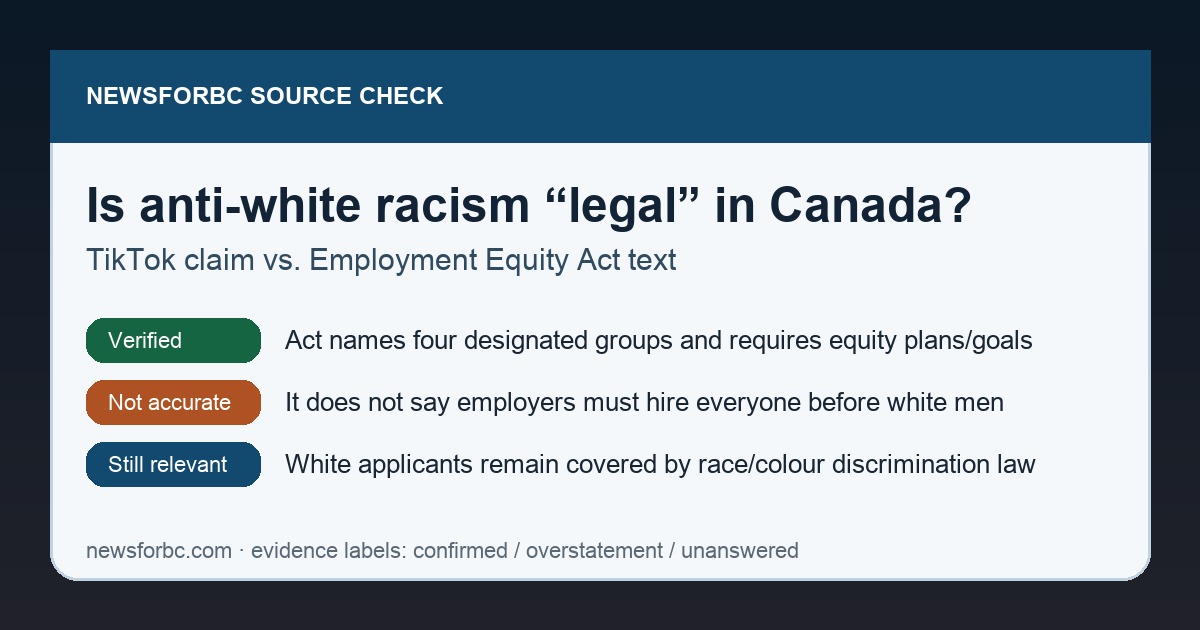
The TikTok is right that the federal Employment Equity Act names designated groups and requires covered employers to address underrepresentation. It is not accurate to say Canadian law simply makes “racism against Caucasians” legal or imposes a universal rule that everyone must be hired before a white man.
What the Employment Equity Act actually does
The federal Employment Equity Act says its purpose is to achieve equality in the workplace and correct disadvantage experienced by women, Aboriginal peoples, persons with disabilities and members of visible minorities. The Act defines members of visible minorities as persons, other than Aboriginal peoples, who are non-Caucasian in race or non-white in colour.
Covered employers must analyze their workforce, identify underrepresentation and employment barriers, make reasonable accommodations and set short-term numerical goals where underrepresentation is found. The federal Labour Program describes the system as promoting barrier-free working conditions and special measures for the four designated groups.
What the TikTok gets wrong
The Act does not use the simple hiring-order rule described in the TikTok. It does not say: “hire every visible minority, woman or Indigenous applicant before any white male.” It speaks in terms of barriers, representation, reasonable accommodation, goals and employer plans.
There is also an explicit limit in the Act for the public sector: it does not require hiring or promotion without merit where the Public Service Employment Act requires merit. That matters. Equity law can change how recruitment and representation are managed, but the statute is not written as a blanket instruction to ignore qualifications.
Is “racism against whites” legal?
As a broad legal claim, no. The Canadian Human Rights Act prohibits discrimination on grounds including race, national or ethnic origin, colour and sex. Those words are not limited to one racial group. B.C.’s Human Rights Code also prohibits employment discrimination on grounds including race, colour, ancestry, place of origin, sex and more.
At the same time, both federal and provincial human-rights systems allow properly designed special programs or equity programs intended to reduce disadvantage. The Charter’s equality section also protects ameliorative programs for disadvantaged groups. That is the legal tension at the centre of the debate: equal treatment of individuals versus targeted measures for groups believed to be underrepresented or disadvantaged.
Where B.C. readers fit in
Many B.C. workers are under provincial employment and human-rights law, but federal employment-equity rules can matter in federally regulated sectors and federal contracting. Government of Canada lists federally regulated private sectors including banks, air transportation, interprovincial trucking and buses, marine shipping and ferries, railways, telecom and broadcasting. B.C. workers in those sectors may be affected by federal employment-equity reporting or workplace-equity rules.
B.C. also has its own Human Rights Code. It prohibits discrimination in employment advertisements, wages, employment and unions/associations on protected grounds, while also allowing employment equity or other special programs whose objective is to ameliorate conditions of disadvantaged groups.
What is confirmed, overstated and unanswered
- Confirmed: the Employment Equity Act designates women, Aboriginal peoples, persons with disabilities and members of visible minorities.
- Confirmed: the Act defines members of visible minorities using “non-Caucasian” and “non-white” wording.
- Confirmed: covered employers must identify barriers, analyze representation and set numerical goals where underrepresentation exists.
- Overstated: the TikTok’s claim that the Act mandates everyone be hired before white men.
- Not accurate as a broad statement: “racism is legal in Canada against Caucasians.” Race and colour are protected grounds in federal and B.C. human-rights law.
- Fair debate: whether employment-equity programs produce individual unfairness, whether targets become quotas in practice, and how employers should prove merit and fairness.
The real accountability question
The serious question is not whether Canadians are allowed to talk about anti-white discrimination. They are. The serious question is how governments and employers prove that equity programs correct real barriers without creating new individual unfairness or turning demographic targets into hidden hiring quotas.
That requires transparency. Covered employers should be able to explain what barriers were identified, what goals were set, how merit was protected, and how complaints from any applicant — including white applicants — are handled.