British Columbians will vote on October 24 after David Eby called a snap election. The campaign opens against a worsening deficit forecast—but a political graphic comparing Eby with John Horgan mixes old estimates, actual results and future projections.
Premier David Eby has sent British Columbia into a provincial election less than two years after the 2024 vote. Elections BC confirms that writs were issued on September 22 and that final voting day is Saturday, October 24, 2026. Advance voting runs October 16–21.
Eby framed the election as a response to the threat posed by U.S. President Donald Trump and his trade war, according to The Canadian Press. Opposition politicians and municipal leaders challenged the timing, with local elections already scheduled for October 17.
For Abbotsford–Mission voters: Elections BC says the September 26 by-election is cancelled. Ballots already cast will not count in the general election. Anyone who voted in the by-election needs to vote again.
An election—and a rapidly changing opposition
The Canadian Press reported that seven CentreBC legislators were returning to the Conservative caucus after the election call, while Eleanor Sturko said she would not return. Interim Conservative leader Lorne Doerkson and Peter Milobar presented the move as an effort to offer a governing alternative. CentreBC’s executive disputed Milobar’s handling of the decision.
Brent Chapman separately announced a move to Dallas Brodie’s OneBC. Those developments should not be confused with an agreement uniting all right-of-centre parties. They also move the story beyond the early-morning speculation discussed in our earlier Brodie interview coverage.
The Conservatives called the election cynical; Green leader Emily Lowan criticized its cost and timing. Vancouver Mayor Ken Sim objected to overlapping provincial and local campaigns. Eby’s stated case is that changing trade conditions require a renewed mandate. Those are competing political arguments, not proof of his private motives.
The deficit is a serious campaign issue. The numbers still need checking.
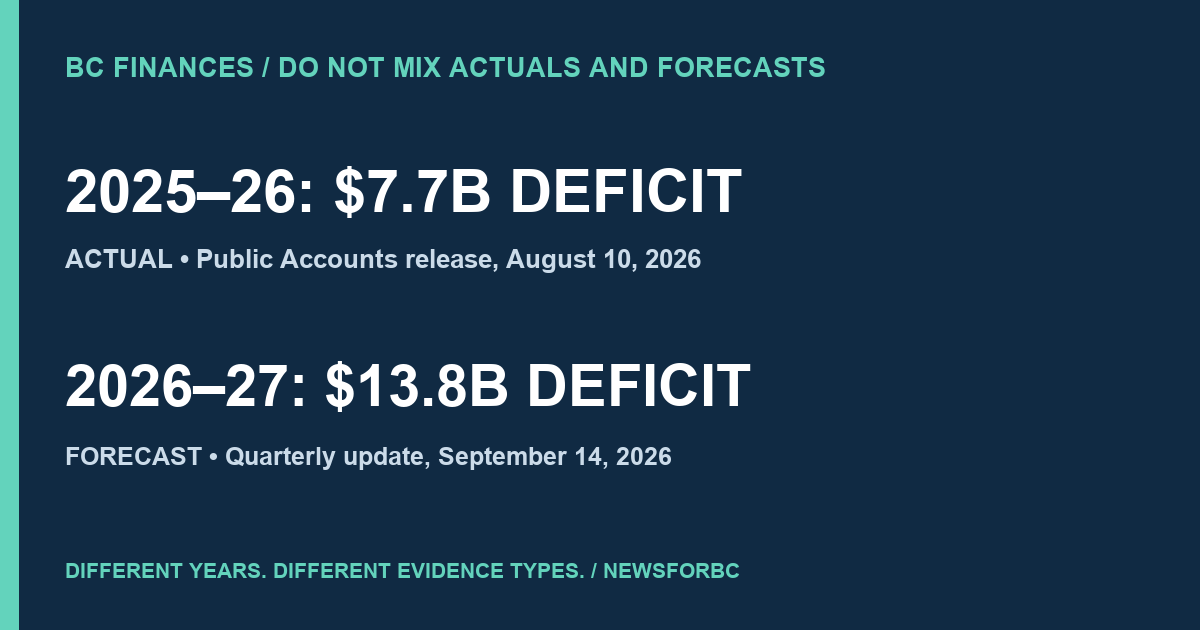
The Province’s September 14 first-quarter update forecasts a $13.8-billion deficit for 2026–27, up $450 million from February’s budget. That is a legitimate accountability issue: voters can ask what is driving the gap, which spending is temporary, which is ongoing, and how each party would pay for its promises.
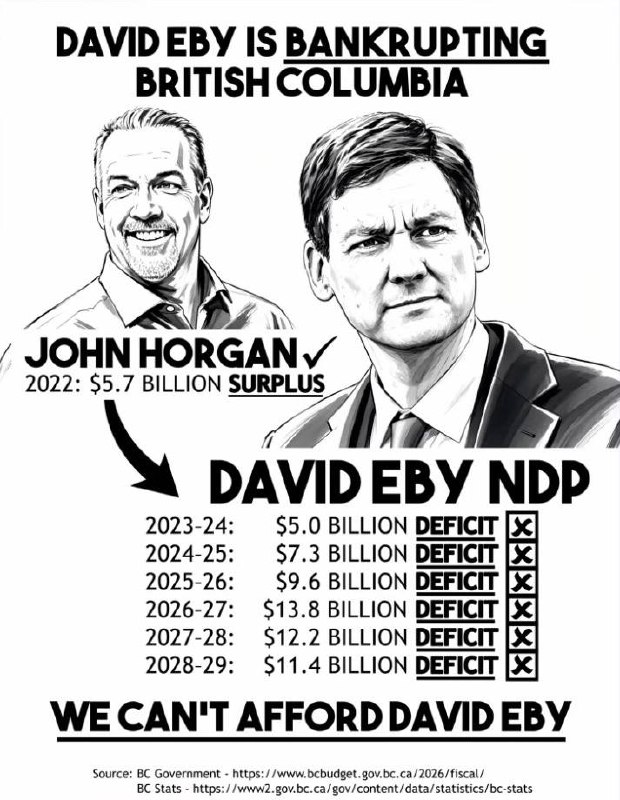
A graphic submitted to NewsForBC declares that Eby is “bankrupting British Columbia,” placing a $5.7-billion surplus beside Horgan and a series of deficits beside Eby. It cites government websites, but does not label any figure as an actual result or a forecast, and calls the surplus simply “2022.” That presentation is not a like-for-like fiscal comparison.
View the political graphic examined in this article
All seven figures, checked against dated records
Amounts below are in Canadian dollars. A fiscal year spans two calendar years. “Actual” means a year-end result reported in Public Accounts, which may be restated in later reports; “forecast” remains an estimate that can change.
2022–23 (graphic says only “2022”)
Graphic: $5.7 billion surplus. Finding: An old forecast—not the year-end result.
The November 25, 2022 second-quarter report forecast a $5.732-billion surplus for 2022–23. The original Public Accounts subsequently reported a $704-million surplus. The latest quarterly historical series restates that actual to $956 million under current accounting policies. Neither actual figure is $5.7 billion; the graphic also obscures the fiscal period.
Fiscal record 1 · Fiscal record 2 · Fiscal record 3 · Fiscal record 4
2023–24
Graphic: $5.0 billion deficit. Finding: Supported as a rounded actual.
Public Accounts reported a $5.035-billion deficit, which rounds to $5.0 billion. The September 2026 historical series continues to show $5.035 billion.
Fiscal record 1 · Fiscal record 2 · Fiscal record 3 · Fiscal record 4
2024–25
Graphic: $7.3 billion deficit. Finding: Supported as a rounded actual.
The August 2025 Public Accounts release reported a $7.3-billion deficit. The latest quarterly historical table gives $7.347 billion, still $7.3 billion when rounded to one decimal place.
Fiscal record 1 · Fiscal record 2 · Fiscal record 3 · Fiscal record 4
2025–26
Graphic: $9.6 billion deficit. Finding: Superseded forecast.
Budget 2026 carried a $9.614-billion forecast for the closing year. Public Accounts released August 10, 2026 subsequently reported an actual $7.7-billion deficit. The graphic uses the old forecast.
Fiscal record 1 · Fiscal record 2 · Fiscal record 3 · Fiscal record 4
2026–27
Graphic: $13.8 billion deficit. Finding: Supported—but it is a forecast.
The September first-quarter update projects $13.759 billion, rounded to $13.8 billion. This is not a completed-year loss; it supersedes February’s $13.309-billion budget forecast.
2027–28
Graphic: $12.2 billion deficit. Finding: Older projection; latest forecast is higher.
February’s Budget 2026 projected $12.165 billion, rounded to $12.2 billion. The September update raises the planned deficit to $12.671 billion—about $12.7 billion. Neither is an actual result.
2028–29
Graphic: $11.4 billion deficit. Finding: Older projection; latest forecast is higher.
February’s Budget 2026 projected $11.437 billion, rounded to $11.4 billion. The September update raises the planned deficit to $11.988 billion—about $12.0 billion. Neither is an actual result.
The corrections do not all favour the same political argument. The graphic’s old 2025–26 forecast is higher than the subsequently reported deficit, while its 2027–28 and 2028–29 numbers are lower than the latest quarterly forecasts. The fair comparison is one clearly dated record, with estimates labelled—not a selection of figures from different updates.
What drove the latest deterioration?
The September update projects revenue $789 million above Budget 2026, but expenses about $1.2 billion higher. The government identifies an additional $614 million for wildfire management and $458 million for refundable tax credits among the major spending changes.
Natural-gas royalties are forecast $531 million below budget. The official backgrounder says approximately $306 million of that reflects correction of calculation errors in the budget’s gas-price forecast; the remainder reflects lower price expectations and revised assumptions for the proposed royalty framework. The net deficit change should not be described as if every dollar came from one error.
The government says it is protecting public services and investing in infrastructure during trade uncertainty. Its first-quarter report projects $12.9 billion in taxpayer-supported capital spending. Capital investment, annual operating deficits and outstanding debt are related, but they are not interchangeable measures.
“Bankrupting” is an accusation, not what a deficit table proves
A deficit means annual expenses exceed revenue. It is not, by itself, evidence that a province cannot meet its obligations. The same quarterly backgrounder forecasts total provincial debt of $180.9 billion and taxpayer-supported debt of $141.1 billion at the end of 2026–27, with a taxpayer-supported debt-to-GDP ratio of 30.1%.
Those figures warrant scrutiny of borrowing, interest costs and long-term affordability. They do not establish insolvency. Nor does assigning each fiscal year to a premier isolate the effects of decisions inherited from an earlier government, tax-revenue changes, one-time settlements, economic conditions or new spending.
The questions every party should answer
- What is your updated revenue and spending plan, using the September quarterly baseline?
- Which savings or tax changes would reduce the deficit, and when would they take effect?
- How much of your plan depends on one-time revenue or uncertain economic growth?
- What independent checks will prevent another material revenue-forecasting error?
- How will you report the cost of election promises alongside debt-servicing and capital commitments?
Those questions are more useful than treating a campaign graphic as audited accounts. The election is real; the fiscal pressure is real; voters deserve figures that distinguish what has happened from what is predicted.
Voting information
- General election: October 24, 2026; polls open 8 a.m.–8 p.m. Pacific time.
- Advance voting: October 16–21. Check Elections BC for locations and opening dates.
- Local elections: October 17. These are separate elections, with separate voting arrangements.
- Candidate nominations: close October 3 at 1 p.m. Pacific time.
- Abbotsford–Mission: the by-election is cancelled; previous by-election ballots do not carry over.
Use Elections BC’s current election page for registration, eligibility, voting options and subsequent changes.