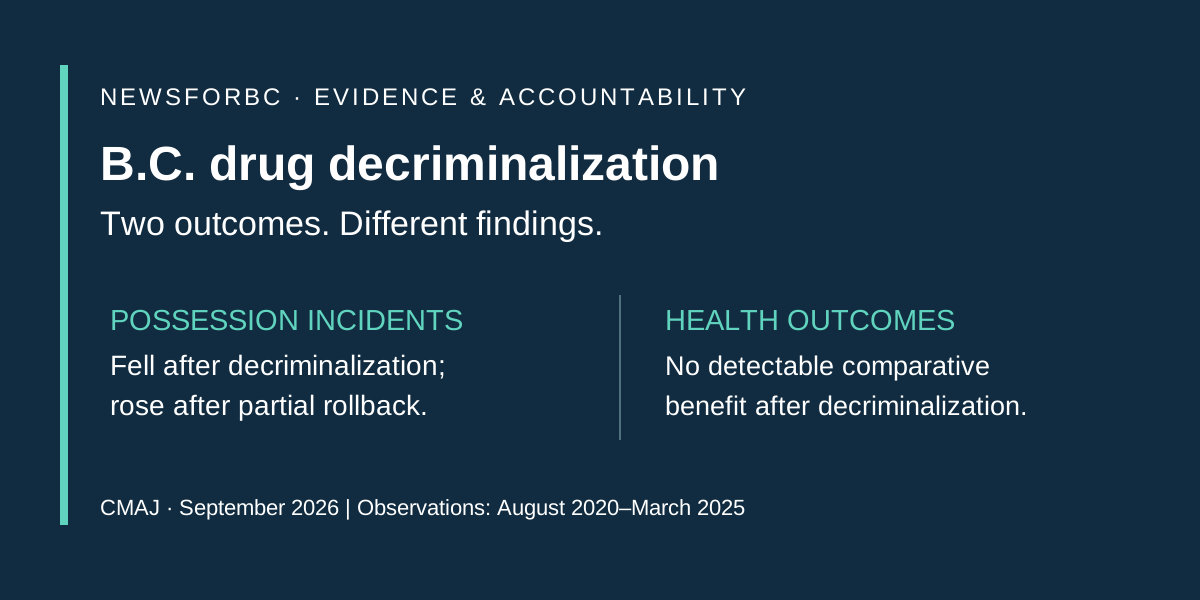
British Columbia’s drug-decriminalization pilot reduced police-recorded possession incidents but did not produce a detectable improvement in overdose deaths or drug-related hospitalizations relative to comparison jurisdictions, according to a new peer-reviewed study in the Canadian Medical Association Journal.
That is a consequential accountability finding for a policy promoted as part of a life-saving response to the toxic-drug crisis. It is not, however, evidence that every drug-policy claim attached to the study is correct. The research did not measure public disorder, establish the effects of prescribed drug alternatives, or test compulsory treatment.
The study by Adrienne Gaudreault and colleagues, published September 14, examined August 2020 through March 2025. Its central distinction is between changing criminal enforcement and improving health: the first changed substantially; a comparative benefit on the measured health outcomes was not demonstrated.
What the researchers actually compared
This was a controlled interrupted time-series analysis, not a randomized trial. Researchers modelled monthly rates before and after policy changes and compared B.C.’s changes with those elsewhere. The question was not simply whether deaths went up or down, but whether B.C. departed from its expected trend differently from comparison regions.
Police data covered Canada. Hospitalization data covered Canada excluding Quebec. Death comparisons were limited to B.C., Alberta and Ontario—not every province. The model divided the record into a pre-policy period, August 2020–January 2023; decriminalization, February 2023–April 2024; and partial recriminalization, May 2024–March 2025.
For decriminalization, the estimated endpoint was April 2024 compared with continuation of the earlier trend. For the rollback, it was March 2025 compared with continuation of the decriminalization-period trend. These are modelled comparisons, not simple before-and-after headcounts.
A clear policing change; no demonstrated comparative health benefit
B.C.’s monthly rate of police-reported possession incidents was estimated to be 39% lower after decriminalization than continuation of the pre-policy trend would predict. After partial recriminalization, it was estimated to be 68% higher than continuation of the decriminalization-period trend.
The corresponding incidence rate ratios were 0.61 and 1.68. These figures concern recorded incidents—not unique people, every police encounter, or necessarily charges. The underlying definition includes incidents police assessed as criminal events whether or not charges followed. Calling the result a reduction in all “police encounters” would broaden the measure beyond the data.
After decriminalization, changes in opioid- and stimulant-related hospitalizations did not differ significantly between B.C. and its comparators. Neither did changes in drug-toxicity deaths compared with Alberta or Ontario. The death comparison ratios were 0.83 against Alberta, with a 95% confidence interval of 0.64–1.06, and 1.07 against Ontario, with an interval of 0.64–1.78.
Those intervals matter. A statistically non-significant result does not establish an exactly zero effect. It means this analysis did not demonstrate a difference with the required statistical confidence; uncertainty remains about effects the study could not reliably distinguish.
The rollback finding needs its own caveat
Deaths and hospitalizations declined during the partial-recriminalization period, but similar improvements occurred outside B.C. Hospitalization changes were not significantly different from the broader comparator, and the death comparison with Alberta was also non-significant.
Table 2 nevertheless contains an important exception to any claim that every comparison was null: the post-rollback mortality ratio against Ontario was 0.47, with a 95% confidence interval of 0.23–0.94. The authors describe Ontario’s pattern as a change relative to its previously declining trend. This comparator-specific difference must not be erased, but it does not establish that recriminalization caused a mortality benefit. The Alberta comparison, at 1.14 with an interval of 0.79–1.66, did not show a significant difference.
The policy timeline—and the promises
- January 31, 2023: the federal exemption began for adults possessing a cumulative total of up to 2.5 grams of specified opioids, cocaine, methamphetamine and MDMA for personal use, subject to exceptions. It did not authorize trafficking or create legal retail sales.
- May 7, 2024: Health Canada approved restrictions on possession in public spaces, while exemptions continued in specified settings, including private residences and overdose-prevention sites.
- January 31, 2026: the exemption expired and was not renewed. This study’s observations ended in March 2025; it does not evaluate that final expiry.
The original government announcement linked the policy to reducing stigma and barriers to services, and to keeping people alive. It is fair to judge the government against those health ambitions, not only the narrower achievement of fewer recorded possession incidents. But mortality was not the policy’s only stated objective.
The federal rollback backgrounder records concerns about public drug use and enforcement. That establishes the stated rationale for restrictions, not proof of what caused disorder. The province’s current policy page confirms the exemption’s expiry.
Where the political argument exceeds the evidence
A Steve Kooner Facebook post sharing a National Post headline argues that the health benefits failed to appear, then links the outcome to public disorder, prescribed supply, treatment resources and a recommendation for mandatory care.
The lack of demonstrated comparative health improvement is supported by the study. The additional causal claims and proposed remedy are political arguments, not results established here. Decriminalization changes possession penalties; prescribed alternatives involve medical provision of drugs; legal retail supply concerns a different distribution framework; mandatory care concerns treatment without consent. Evidence about one cannot automatically settle the others.
Senior author Daniel Myran told Postmedia reporter Sharon Kirkey that the data did not support promised major reductions in overdoses. The province had already acknowledged disappointment: in her January 14 nonrenewal statement, Josie Osborne said the pilot “has not delivered the results we hoped for.” Neither statement resolves the study’s causal limitations.
What remains unanswered
The authors acknowledge short follow-up, broad confidence intervals and possible unmeasured confounding from drug supply, service availability and other changes. The baseline overlapped the pandemic. Province-level results may also conceal local differences. Public drug use, community safety, stigma and treatment engagement were not assessed.
Government should now explain which promised outcomes were achieved, which were not demonstrated, and what evidence supports its replacement approach. Useful reporting would connect treatment access and waiting times, continuity of care, toxic-supply trends and community-safety measures to clearly defined targets—without pretending this single study measured them all.
The defensible conclusion is neither a clean bill of health nor a verdict on every competing policy. B.C. changed possession enforcement without demonstrating the hoped-for comparative improvement in the health outcomes examined. That warrants scrutiny of both the original promises and the evidence behind what comes next.
Sources and reporting method
Read the original CMAJ paper or readable full text at PMC. See our source note and rights statement, claim table and study metadata. This article is original document-based reporting, not an interview or a reproduction of the paper.