BC History / Source Check
Viral Reel shows Vancouver in 1907 — and the filmmaker’s Titanic connection is real
A short Facebook Reel has put early Vancouver back into view: horses, streetcars, cyclists and pedestrians moving through a city that was barely two decades old. The core archive claim checks out — with a few important caveats.
What the Reel says
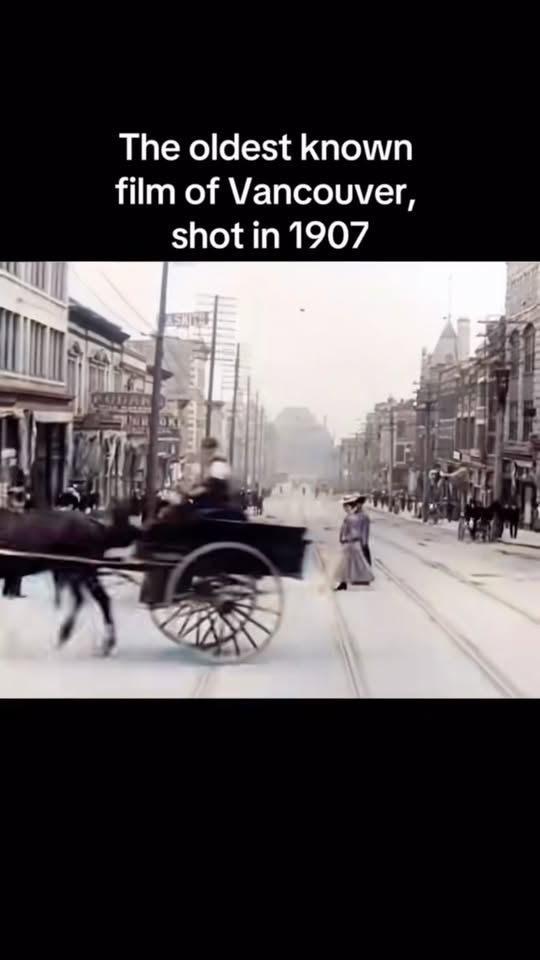
The Facebook Reel, posted by BC Bob, says the footage is “the oldest known film of Vancouver, shot in 1907.” Its caption adds that the man who filmed it, William Harbeck, was later hired to film the Titanic’s maiden voyage and did not survive that assignment. The Reel describes the short clip as stabilized, colourized and restored.
The downloaded Reel is about 18 seconds long. There is no useful spoken narration; the story is carried by the visual footage and caption.
Watch the Facebook Reel source lead →
What the source trail confirms
The strongest independent source located is the City Reflections: Vancouver 1907 | 2007 project page, which says its 53-minute feature is based on the “earliest known surviving film footage of Vancouver,” shot in 1907 by William Harbeck from the front platform of a streetcar as it travelled through downtown and the West End.
The Vancouver Historical Society’s YouTube posting for City Reflections gives a more precise date: May 7, 1907. It says Harbeck captured Vancouver street scenes from the front of a moving B.C. Electric Railway streetcar, and describes the film as the earliest known surviving footage of the city.
The same City Reflections source trail also says Harbeck died in the Titanic disaster of 1912. Separate search results for Titanic history sources also identify Harbeck as a filmmaker connected with Titanic passenger/victim history, though NewsForBC treats that as a secondary historical detail rather than the main Vancouver claim.
Why the footage matters
The short clip works because it collapses a century of Vancouver growth into a few seconds. The city seen in the Reel is not glass towers and traffic congestion. It is streetcar tracks, horses, long skirts, bicycles, overhead wires, low-rise storefronts and pedestrians moving at a human pace.
That does not make the Reel a complete history lesson. It is a restored excerpt circulating on social media. But the core archive trail points to a real and important Vancouver-history project: City Reflections, which paired Harbeck’s 1907 footage with a 2007 re-filming of the same route to show a century of change.
What still needs careful wording
NewsForBC found support for the main points that the footage was shot by Harbeck in 1907, that it is described by the City Reflections/Vancouver Historical Society source trail as the earliest known surviving Vancouver film footage, and that Harbeck later died in the Titanic disaster.
One detail from the Reel caption — that the entire original film plays on a loop at the Museum of Vancouver in Vanier Park — should be treated as attributed to the Reel caption unless separately confirmed by the museum. The Museum of Vancouver exists at Vanier Park and remains an obvious place for Vancouver-history visitors to check, but NewsForBC is not presenting the display-loop claim as independently verified in this article.
Bottom line
The Reel is a social-media doorway into a real piece of B.C. history. The archival source trail supports the core claim: Vancouver’s earliest known surviving moving images were shot in 1907 by William Harbeck from a streetcar. The Titanic connection is also part of the Harbeck story, but the larger lesson is local: British Columbia’s cities are young enough that their transformation from streetcar streets to modern skylines can still be watched on film.