Reader note: This article checks a viral meme. It does not adopt the post’s racialized conclusion about Indigenous culture. Social posts are leads; treaty records, company releases and original reporting are the anchors.
Short verdict
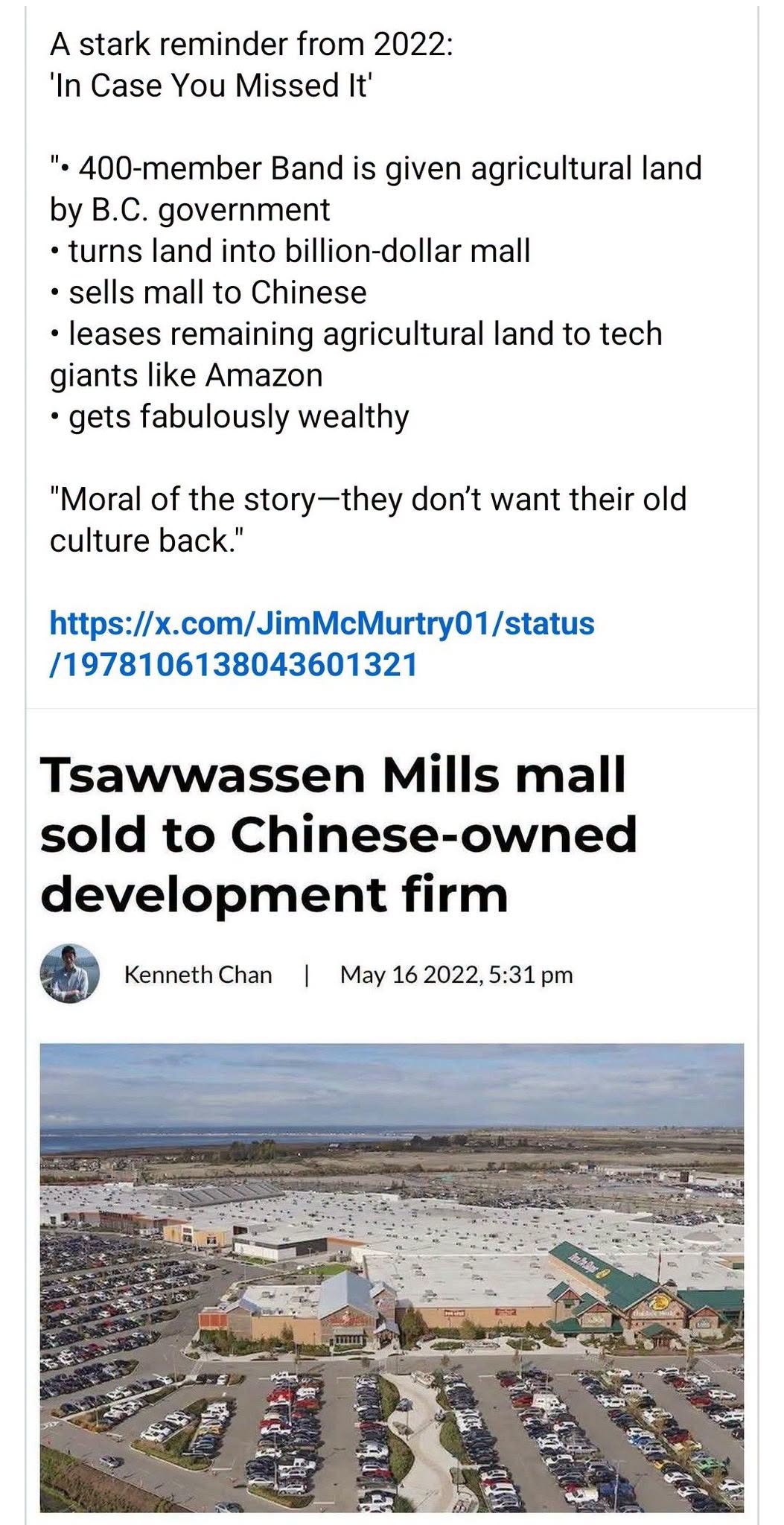
Partly true, but heavily framed. The meme points to real developments: Tsawwassen Mills was built on Tsawwassen First Nation treaty lands through a long-term lease; the mall was later sold by Ivanhoé Cambridge to Central Walk; Amazon leased a major Delta iPort fulfillment facility on Tsawwassen First Nation lands. But the meme leaves out the treaty context, appears to confuse sale of the mall/leasehold with sale of the underlying land, and turns a public land-use question into a collective cultural attack.
What the records show
| Claim | Evidence label | What NewsForBC found |
|---|---|---|
| “400-member Band” | Mostly supported but dated/simplified | B.C.’s 2025 treaty page lists Tsawwassen First Nation population as 416. TFN’s 2023/24 annual report lists 532 members, with 260 on-lands and 272 off-lands at the reporting date. |
| “Given agricultural land by B.C. government” | Misleading | The land came through the Tsawwassen First Nation Final Agreement, a modern treaty negotiated by Canada, B.C. and TFN. The agreement followed assertions of Aboriginal rights/title and created self-government and treaty lands. It was not simply a unilateral B.C. gift. |
| “Turns land into billion-dollar mall” | Overstated / unclear | Daily Hive reported Tsawwassen Mills is a 1.2-million-sq-ft mall on 107 acres and said the latest assessed value was $407 million at the time of sale. “Billion-dollar mall” is not established by the sources captured here. |
| “Sells mall to Chinese” | Real transaction, imprecise wording | Daily Hive reported the mall was sold to Nanaimo-based Central Walk and described Central Walk as owned by a Mainland Chinese investor. The same article says Tsawwassen Mills was built through a long-term lease from TFN. The meme does not show that TFN sold the underlying treaty land. |
| “Leases remaining agricultural land to Amazon” | Partly supported, wording needs care | GWL Realty Advisors and HOOPP reported Amazon leased 450,000 sq. ft. at Delta iPort, an industrial park developed on lands leased from TFN. Calling it “remaining agricultural land” requires land-status proof not supplied by the meme. |
| “Gets fabulously wealthy” | Not proven by meme | TFN’s annual report shows major assets, lease revenue structures and economic-development work, but the meme’s phrase is rhetorical, not a public-accounting conclusion. |
| “They don’t want their old culture back” | Opinion / rejected framing | TFN’s own annual report describes language, culture, community, Treaty rights and self-government work alongside economic development. The meme’s cultural conclusion is not evidence. |
The treaty piece the meme skips
The Tsawwassen First Nation Final Agreement came into effect on April 3, 2009. B.C.’s treaty page says it was negotiated among Canada, British Columbia and Tsawwassen First Nation under the B.C. treaty process. The federal final-agreement text states that Tsawwassen First Nation had not previously entered into a treaty or land claims agreement with the Crown and that the parties negotiated the agreement to provide certainty around Aboriginal rights and self-government.
That matters because the meme’s phrase “given agricultural land by B.C. government” strips away the legal context. A modern treaty settlement is not the same thing as a simple discretionary handout. It is also not the same policy question as foreign billionaire purchases of ALR farmland, which NewsForBC has covered separately.
The mall sale: who sold what?
Daily Hive reported in 2022 that Tsawwassen Mills, a 1.2-million-sq-ft mall on 107 acres, was sold to Nanaimo-based Central Walk. It also reported the mall was previously owned by Ivanhoé Cambridge and built through a long-term lease from Tsawwassen First Nation.
That distinction is critical. The viral meme says “sells mall to Chinese,” but the reporting NewsForBC reviewed points to a sale by Ivanhoé Cambridge of the mall asset/ownership interest. The underlying land relationship is described as a lease from TFN. A sale of mall ownership is not automatically a sale of treaty land.
The Amazon/Delta iPort piece
GWL Realty Advisors and HOOPP announced in 2018 that Amazon would occupy 450,000 sq. ft. at Delta iPort, a new industrial park being developed by GWL on behalf of HOOPP on lands leased from Tsawwassen First Nation. The same release said the first phase was part of a 57-acre industrial park that would offer nearly one million sq. ft. of distribution space when complete.
So yes: Amazon on TFN lands is real. But the stronger public-interest issue is not a racial meme. It is land-use governance: how treaty lands, industrial logistics, port adjacency, lease revenues, local employment, ALR policy and public accountability fit together in Metro Vancouver.
What Tsawwassen sources say about benefits
The Tsawwassen Mills site says the 2008 treaty agreement was followed by a land-use plan aimed at new economic opportunities and self-reliance, including Tsawwassen Mills. It says TFN commercial-land development generated significant employment opportunities and that a Members Benefits Package provides ongoing revenues to support social, health and education programs plus municipal infrastructure.
TFN’s 2023/24 annual report also shows this is not only a mall story. It describes leasehold residents, commercial and industrial leaseholders, property-tax authority work, economic development committees, industrial-land strategy, short-term leasing initiatives, and continued language/culture/community programming.
Why this updates the NewsForBC land story
The earlier NewsForBC farmland piece focused on foreign and corporate ownership of B.C. agricultural land, the Agricultural Land Reserve, and whether B.C. should control land ownership more directly. This Tsawwassen example is different because it involves modern treaty land and First Nation self-government. But it belongs in the same land ledger for one reason: British Columbians are arguing over who controls land, who benefits from land value, and what public accountability should follow when land changes from farms or community lands into malls, logistics parks or private investment assets.
The responsible debate is not “Indigenous culture versus money.” The responsible debate is: what records should be public, what benefits should be transparent, what land-use rules should apply, and how B.C. balances reconciliation, food security, port logistics, jobs and local control.
Questions B.C. should ask now
- When treaty lands are converted to major commercial or industrial use, what public information should be available about lease terms, public infrastructure costs and community benefits?
- Should B.C.’s farmland debate distinguish more clearly between ALR ownership, treaty settlement lands, Crown land transfers, and private corporate purchases?
- When foreign-owned or foreign-capital-backed firms buy major commercial assets on leased treaty lands, what disclosure should the public expect?
- How much of the benefit reaches members, local workers, public services and surrounding communities?
- Can B.C. support Indigenous self-government and still ask hard, non-racial questions about land-use transparency?
Source trail
- Facebook post lead
- Daily Hive: Tsawwassen Mills sold to Central Walk
- CTV: Tsawwassen Mills has a new owner
- Tsawwassen Mills: Tsawwassen First Nation page
- Crown-Indigenous Relations: Tsawwassen First Nation Final Agreement
- B.C. treaty page: Tsawwassen First Nation
- GWL Realty: Amazon Delta iPort lease
- HOOPP: Delta iPort deal with Amazon
- NewsForBC source note and captures