What the TikTok got right
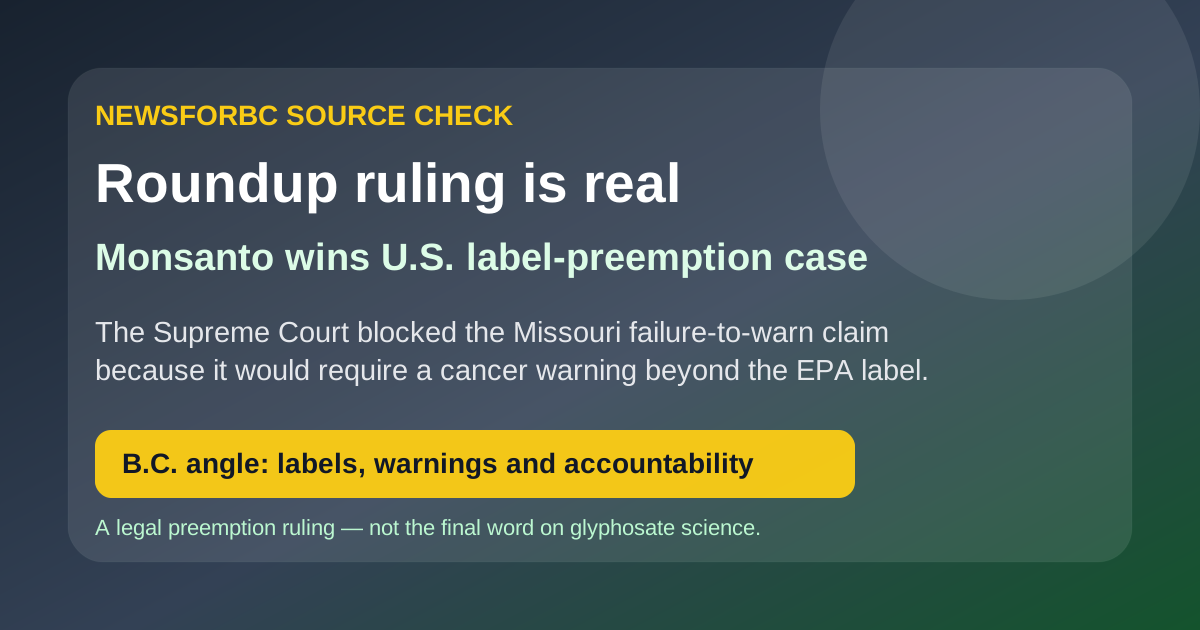
Confirmed: On June 25, 2026, the U.S. Supreme Court released Monsanto Company v. John L. Durnell, No. 24-1068. The Court ruled for Monsanto in a 7-2 decision.
Confirmed: The holding says the Federal Insecticide, Fungicide, and Rodenticide Act — FIFRA — expressly preempts Durnell’s state-law failure-to-warn claim because that claim would require Monsanto to add a cancer warning to Roundup’s label.
Confirmed: Justice Brett Kavanaugh wrote the opinion. Chief Justice Roberts and Justices Thomas, Alito, Sotomayor, Kagan and Barrett joined. Justice Thomas also wrote separately. Justice Jackson dissented, joined by Justice Gorsuch.
What the ruling actually does
The case came from Missouri. John Durnell alleged that about 20 years of Roundup use caused his non-Hodgkin’s lymphoma. A jury awarded him more than $1 million on a failure-to-warn theory, and the Missouri Court of Appeals affirmed.
The Supreme Court reversed. Its reasoning was not that no one can ever sue over Roundup. The narrower ruling was that, where the Environmental Protection Agency approved a label without a cancer warning and federal law requires the manufacturer to use the EPA-approved label, a state-law verdict requiring a different cancer warning is preempted by federal law.
In plain English: a state jury cannot use state failure-to-warn law to force a Roundup cancer warning that conflicts with the federally approved pesticide label.
What the ruling does not prove
- It does not prove Roundup is safe in every use or exposure scenario.
- It does not resolve the entire scientific debate over glyphosate and cancer.
- It does not directly change Canadian law, B.C. pesticide rules or Health Canada pesticide approvals.
- It does not mean every Roundup lawsuit disappears. The article’s focus is the failure-to-warn theory tied to the label.
Why this matters in B.C.
B.C. readers should care because the ruling shows how much power federal pesticide regulators can have over warnings, labels and civil lawsuits. Canada has its own version of this problem: Health Canada’s Pest Management Regulatory Agency approves pesticide products and labels under the Pest Control Products Act, while B.C. regulates pesticide use, training, certification and enforcement through provincial pest-management rules.
The U.S. decision does not bind Canadian courts. But the policy question crosses the border: when a federal regulator approves a pesticide label, how much room should injured people, provinces, municipalities or juries have to demand stronger warnings?
The Canadian regulatory context
Health Canada’s glyphosate fact sheet says glyphosate is the most widely used herbicide in Canada and that pesticides must be approved by Health Canada before they can be imported, sold or used in Canada. Health Canada says its primary objective in pesticide regulation is to protect human health and the environment.
Health Canada’s fact sheet also says that its 2017 re-evaluation granted continued registration of products containing glyphosate for sale and use in Canada, with label changes to provide additional safety-use information. It says Health Canada’s proposed findings were that, when used according to label instructions, glyphosate products were not expected to pose risks of concern to human health or the environment.
That is not the only scientific voice. The International Agency for Research on Cancer classified glyphosate in 2015 as “probably carcinogenic to humans” — Group 2A — based on limited evidence in humans, sufficient evidence in experimental animals and strong evidence for genotoxicity.
The B.C. accountability questions
For British Columbia, the immediate issue is not whether a Missouri failure-to-warn verdict survives U.S. federal preemption. It is whether B.C. residents, workers, farmers, landscapers and local governments get transparent answers on pesticide exposure and warnings.
B.C. should ask:
- Which glyphosate products are used by provincial agencies, municipalities, utilities, rail corridors and contractors?
- What labels, safety data sheets and exposure instructions are workers actually given?
- Are applicators trained and certified where required?
- Are use records public enough for residents to know what is being sprayed near homes, parks, rights-of-way or water?
- Does Canada’s label system give enough practical warning to ordinary users, not just commercial applicators?
- When scientific authorities disagree, who carries the uncertainty — the manufacturer, the regulator, the worker or the patient?
Evidence labels
The bottom line
The viral post is not fake. The Supreme Court decision is real and significant. But the careful version is this: the Court protected Monsanto from one major kind of state-law warning lawsuit because federal pesticide label law controlled the label. That is a legal preemption ruling, not the final word on glyphosate science and not a Canadian ruling.
B.C. readers should take the ruling as a warning about regulatory accountability. If a label becomes the shield, the label process must be open, current, independent and understandable to the people who live with the exposure.