
B.C. history · residential schools · source-check
RCMP residential-school task-force post: what the report does — and does not — prove
A Facebook post says an RCMP task-force investigation into B.C. residential schools found no proof of homicides or clandestine burials. The record behind that claim is real — but the social-media conclusion needs tighter wording.
What the Facebook post showed
The public Facebook metadata resolved to a post by Kim J. Dobranski. Facebook exposed this description: “An RCMP task force investigation into British Columbia Indian residential schools reviewed historical allegations and found no proof of homicides or clandestine burials...” The attached image says the RCMP task force reviewed B.C. school records, including Kamloops, and says specific allegations of deliberate killings or secret burials were not substantiated by physical or historical evidence.
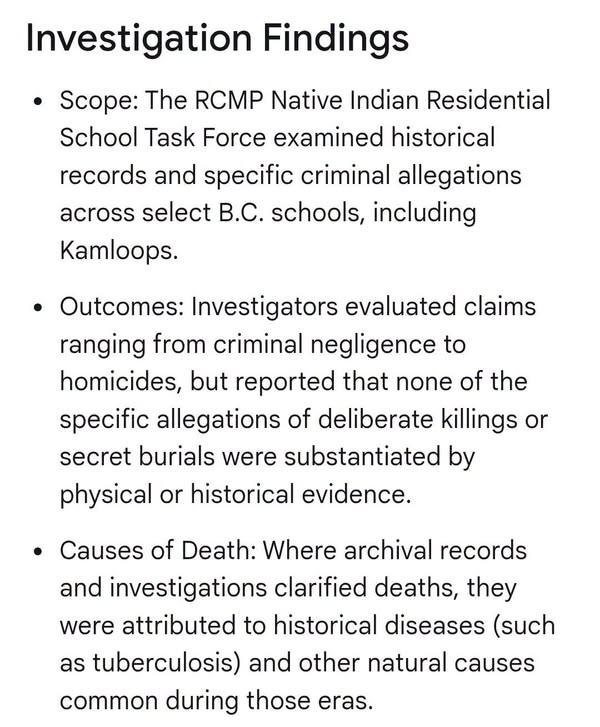
Facebook full post/media was login-gated for direct extraction; NewsForBC preserved the public HTML, OpenGraph image and OCR text.
The real document trail
The key record is the Final Report of the Native Indian Residential School Task Force, Project E-NIRS (1994–2003), from RCMP E Division. IJF’s Open By Default database lists it as access-to-information release A-2021-10504, released August 2023, 139 pages.
IJF reporter Bethany Lindsay reported that the task force was created after allegations from Alberni Indian Residential School and grew into a province-wide investigation into abuse allegations at 15 B.C. residential schools. The Tyee republished the IJF story. The article says the task force collected more than 4,000 tips, including complaints against 129 people and 974 allegations of criminal misconduct.
That history matters because the social post could be misread as “the RCMP found nothing.” That is not accurate. IJF/Tyee reported that charges against 14 men were linked to the task-force work, while also noting that four were charged before the team was formed and two cases used evidence largely gathered earlier.
What the homicide/burial point can safely say
The careful version is this: the task-force report, as publicly described and later quoted, did not substantiate the specific homicide or clandestine-burial allegations it investigated. That is a significant public-record point, especially because the report was not widely available for years.
The unsafe version is broader: “there were no dead children,” “there was no abuse,” or “all residential-school burial claims are a hoax.” Those claims do not follow from the task-force record reviewed here.
Kamloops is still a separate investigation
Tk̓emlúps te Secwépemc issued a Feb. 17, 2026 update saying its former Kamloops Indian Residential School investigation remains active and ongoing. The update says investigators used ground-penetrating radar, LiDAR and historic human-remains detection dogs; that some areas were ruled out; that other areas could not confidently be ruled out; and that signatures resembling burials were found in some areas.
The Nation also said access to government and Catholic Church records remains critical and that future outcomes could include preserving the orchard as a sacred site or excavation, subject to cultural protocols, laws, forensic work and consultation with 38 affected Nations.
The RCMP role is also not erased
The RCMP’s own public page says more than 150,000 Indigenous children were removed from families and communities for residential schools. The RCMP’s 2011 report says police were linked to the system through duties such as truant enforcement and that many former students learned to fear and distrust the RCMP. Former commissioners apologized in 2004 and 2014 for the force’s role.
So the record cuts two ways: it can narrow unsupported claims about specific murders or secret burials, while still confirming serious abuse investigations and the broader state/church/police context of residential schools.
Claim-by-claim
| Claim | Status |
|---|---|
| A B.C. RCMP Native Indian Residential School Task Force existed. | Confirmed. IJF/Tyee describe a B.C. RCMP task force created in the mid-1990s to investigate abuse allegations at 15 B.C. residential schools. |
| The final report is public through IJF/Open By Default. | Confirmed with access caveat. IJF record A-2021-10504 identifies a 139-page RCMP release. Direct DocumentCloud PDF capture was blocked in this environment. |
| The report found no proof for specific homicide or clandestine-burial allegations it examined. | Supported narrowly. NewsForBC frames this as specific investigated allegations, not a universal finding about every school or every later search. |
| The task force found no abuse. | False. IJF/Tyee reported thousands of tips/allegations and charges linked to 14 men. |
| The report disproves the Kamloops investigation by itself. | Not established. Tk̓emlúps te Secwépemc says its independent, post-2021 investigation remains ongoing. |
| The public should be able to read the report and underlying records. | Reasonable transparency question. The IJF database makes the report identifiable, and the IJF residential-schools database can help compare school records, allegations and outcomes. |
Bottom line
The Facebook post points to a real and important record. The best NewsForBC framing is not denial and not blind acceptance. It is: publish the report trail, quote the limits, preserve survivor-abuse context, and separate proven records from broader social-media conclusions.
Sources
- Investigative Journalism Foundation: The untold story of Canada’s only province-wide police investigation into residential school abuses.
- IJF Open By Default record A-2021-10504.
- The Tyee republication of the IJF story.
- RCMP: Indian Residential Schools and the RCMP.
- Tk̓emlúps te Secwépemc Feb. 17, 2026 investigation update.
- National Centre for Truth and Reconciliation reports page.

.jpg)