B.C. wildlife · Nelson · grizzly bears · WildSafeBC · source-check · 2026-08-30
Nelson grizzly deaths and WildSafeBC resignation: what the Facebook post leaves out
A Facebook photo post from WildSafeBC Nelson points readers to a MyNelsonNow story on Lisa Thomson’s resignation after the killing of a grizzly sow and two yearlings. The image captures one piece of a larger West Kootenay story: enforcement decisions, attractants, relocation limits, public grief and online backlash.
Original Facebook shareSource noteClaim tableCaptured Facebook image
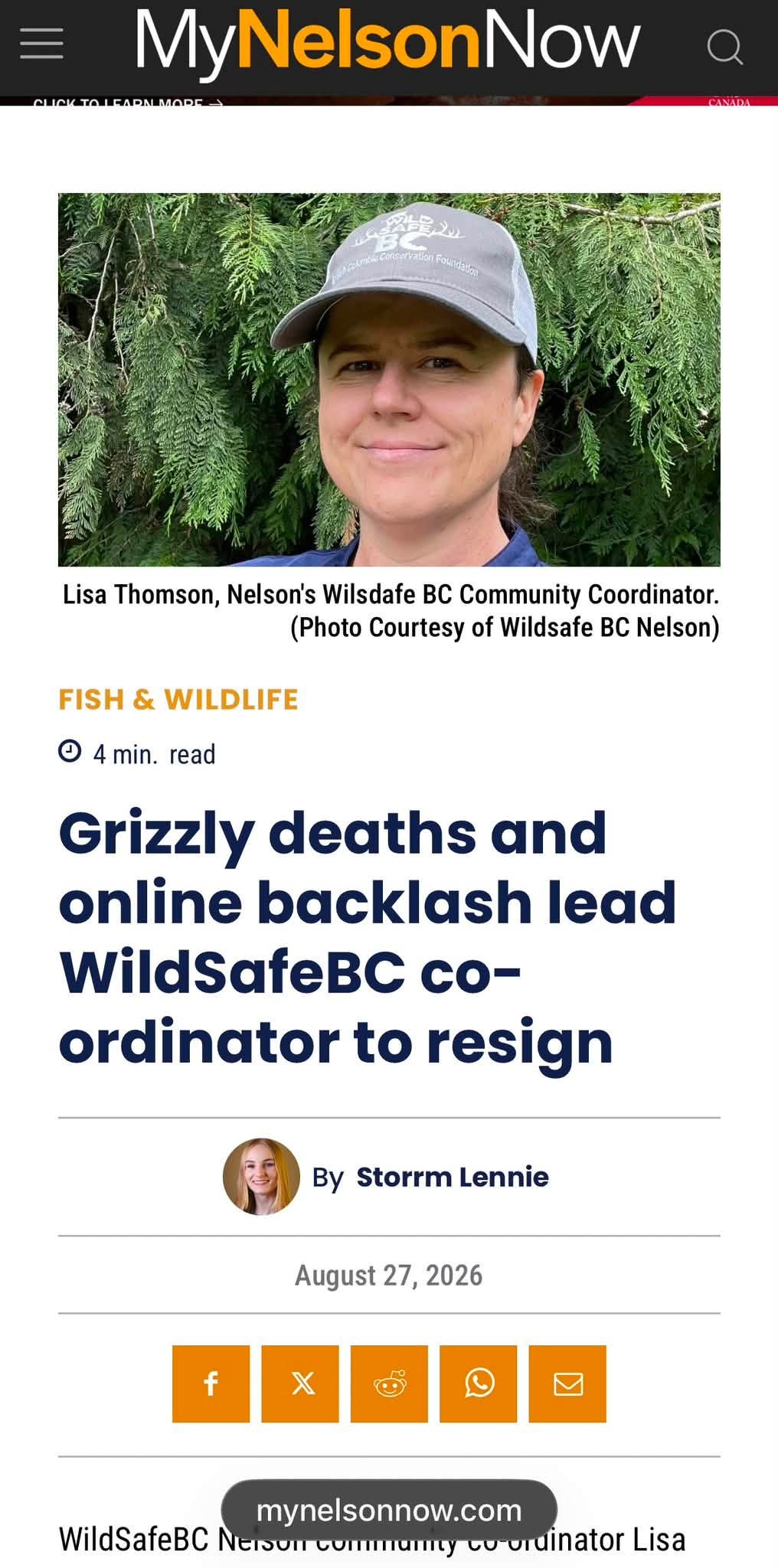
What the Facebook post shows
The shared image is a MyNelsonNow article preview headlined “Grizzly deaths and online backlash lead WildSafeBC co-ordinator to resign”, by Storrm Lennie, dated Aug. 27, 2026. The image identifies Lisa Thomson as Nelson’s WildSafeBC community co-ordinator.
Timeline from the source trail
- 2023: reporting says the same grizzly sow had been relocated from Nelson with a previous set of offspring, then returned.
- Aug. 13–14, 2026: CBC and local reporting say a yearling with a leg injury/deformity was killed. BCCOS cited age, injury and conflict history; advocates said the bear was mobile and not aggressive.
- Aug. 14: MyNelsonNow reported BCCOS killed the sow after food-conditioned behaviour, loss of fear of people, repeated access to residential properties and non-natural foods such as fruit trees and barbecues. Two yearlings were captured and relocated to an undisclosed location.
- Aug. 24: MyGrandForksNow reported the relocated Nelson yearlings were being seen in Christina Lake, with WildSafeBC Nelson connecting them through timing, physical appearance, ear tags and radio collars.
- Late August: CBC reported one relocated yearling was killed near Christina Lake after accessing non-natural food sources and coming close to people, while the remaining yearling had moved on and was being monitored.
- Aug. 27–30: MyNelsonNow, Castanet and CBC reported Thomson’s resignation and her call for change after “multiple failures” and online misinformation/personal attacks.
Education versus enforcement
One point matters for public anger: WildSafeBC is not the Conservation Officer Service. Thomson told MyNelsonNow, “They’re enforcement. We are education.” WildSafeBC’s role is prevention, education, neighbourhood canvassing and helping residents secure attractants. BCCOS is the enforcement body that responds to wildlife conflicts and makes public-safety decisions.
The attractant problem
The sources repeatedly return to garbage, fruit trees, compost, chickens, barbecues and other non-natural food. CBC quoted wildlife biologist Clayton Lamb saying communities need stronger policies to reduce attractants before conflicts start. Thomson told CBC that the bears repeatedly returned because of abundant feral fruit trees and said relocation cannot simply manage the problem.
Her sharpest line may be the most useful policy summary: coexistence does not mean allowing a backcountry apex predator to hang out next to a barbecue in someone’s backyard.
Claim/source table
| Point | What records show |
|---|---|
| WildSafeBC Nelson shared an article about Lisa Thomson resigning. | Confirmed by the visible Facebook photo/post and image transcription. The image shows WildSafeBC Nelson sharing the MyNelsonNow article preview. |
| Lisa Thomson resigned after five seasons as WildSafeBC Nelson community co-ordinator. | Reported by MyNelsonNow and Castanet; CBC describes her as the outgoing community co-ordinator and says she announced resignation after the killings. |
| A grizzly sow and two of her three yearlings were killed this month. | Reported by CBC and MyNelsonNow. One yearling with a leg injury/deformity was killed; the sow was killed Aug. 14; a relocated yearling was later killed near Christina Lake. Another yearling was relocated/monitored. |
| BCCOS killed the bears simply because people complained online. | Not established. BCCOS reporting cited food-conditioned behaviour, loss of fear of people, conflict history, age/health issues, and public-safety concerns. Online backlash is part of the resignation story, not the stated official basis for dispatching bears. |
| WildSafeBC made the enforcement/kill decisions. | Rejected by Thomson’s statements. She told MyNelsonNow “They’re enforcement. We are education,” distinguishing BCCOS enforcement from WildSafeBC education/prevention. |
| The yearling with a limp was mobile and not aggressive. | Reported by advocates/residents in CBC and Kootenay Co-op accounts. BCCOS said age, injury and conflict history made it unsuitable for rehabilitation or relocation; conflict specifics remain records-wanted. |
| Attractants such as garbage, fruit trees, compost, chickens and barbecues are central. | Supported across CBC, MyNelsonNow, WildSafeBC and B.C. prevention context. Thomson and wildlife biologist Clayton Lamb emphasize stronger attractant control before bears become food-conditioned/habituated. |
| Relocation alone fixes habituated/food-conditioned grizzlies. | Not supported. CBC quotes Lamb saying rehabilitation/relocation is very challenging once bears become habituated or food conditioned, especially when comfortable in town. |
| Nelson needs system-level changes. | Supported as Thomson’s argument, not as a completed policy finding. She calls for coordinated resident, municipal and business action, stronger bear-smart communities, funding and enforcement. |
| The public can fairly judge the killings from social posts alone. | No. A fair judgment needs BCCOS incident records, conflict-report details, veterinarian/biologist advice, relocation risk assessments, attractant-enforcement records and municipal waste/fruit-tree policy evidence. |
Records still needed
NewsForBC could not fairly judge every lethal decision from public articles alone. The records that would matter include:
- BCCOS incident logs and RAPP calls for this bear family.
- Specific “conflict history” details cited for the first yearling.
- Provincial veterinarian and wildlife-biologist recommendations.
- Relocation risk assessments and monitoring records for the sow/yearlings.
- Municipal enforcement records for unsecured garbage, fruit trees, compost and other attractants.
- City of Nelson / RDCK waste, bylaw and bear-resistant-bin funding decisions.
- Any post-incident review of what alternatives were considered before lethal action.
NewsForBC view
The online debate should not be reduced to “save every bear” versus “public safety at any cost.” Once grizzlies are food-conditioned and comfortable near people, relocation becomes harder and risk rises. But if the same family was known for years, the public deserves to know whether attractant enforcement, municipal infrastructure and early hazing/prevention were strong enough before the final choices became lethal.
Thomson’s resignation makes the story more than a wildlife incident. It is now a civic-governance story about rural growth, backcountry pressure, local bylaws, online mob behaviour, non-profit burnout and whether B.C. communities are funding prevention before conflict reaches the Conservation Officer stage.
Source package
The source package preserves the Facebook image, article captures, search trail, claim table and source note. The Facebook URL did not contain a downloadable video; yt-dlp returned an unsupported photo-post URL.