Editorial note: This article is about the distribution problem created when Canadian news links cannot be shared on Meta platforms. It is not criticism of Michael Dowling or CTV News Vancouver. Readers should visit CTV for the original reporting.
What happened
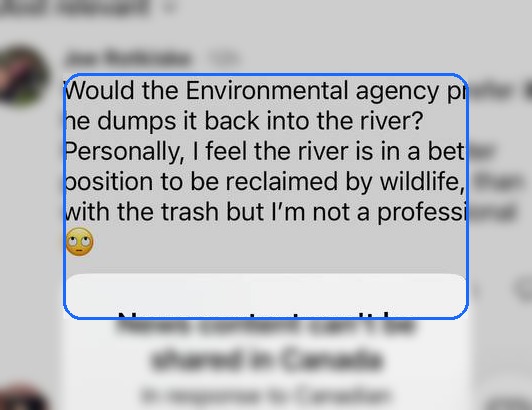
When The Ledge attempted to share CTV News Vancouver’s recent positive feature on Michael Dowling, the post was blocked by a Meta notice stating: “News content can’t be shared in Canada.” The popup added: “In response to Canadian government legislation, news content can’t be shared.”
The blocked article was Adam Sawatsky’s Sawatsky Sign-Off story, “‘I got a self-taught PhD in garbology’: B.C. man reconnects with childhood passion for picking up litter”, published by CTV News Vancouver on June 16, 2026.
The story that could not be shared
CTV’s piece introduces Michael Dowling, a B.C. man who reconnected with a childhood concern for clean water and the natural world by picking up litter. The story describes his recovery from alcoholism, his return to humble environmental work and his message to “adopt your block” and “adopt your beach.”
In other words, this was exactly the kind of local, useful, non-toxic story communities usually want to pass around: a person doing something positive, practical and close to home.
Why the block appears
Meta announced in 2023 that, in response to Canada’s Online News Act, it would end news availability on Facebook and Instagram for people accessing those platforms in Canada. Meta’s own notice said that people in Canada would no longer be able to view or share news content on Facebook and Instagram, including articles and audio-visual content posted by news outlets.
The federal law’s stated purpose is to regulate digital news intermediaries “with a view to enhancing fairness in the Canadian digital news marketplace” and contributing to the sustainability of Canadian news businesses, including independent local outlets. The public-policy goal was to support news. The lived user experience, in this case, is that a good-news local story could not be shared in the place many neighbours still use to talk.
Why it matters for B.C.
British Columbia local news already has a reach problem. A regional TV story, newspaper item or community feature may be well reported and still vanish quickly if readers cannot circulate it where their friends, local groups and neighbourhood pages are active.
The loss is not only political-news traffic. It affects softer civic stories too: recovery, litter cleanup, beach stewardship, volunteerism and the small human-interest pieces that remind people their community still has people doing good work.
NewsForBC view
Canada can debate the Online News Act, platform power and publisher compensation. But this example shows the collateral damage clearly. A story about picking up garbage and staying sober should not be hard for British Columbians to share.
Until the policy and platform standoff changes, source-card pages like this one can help preserve context, point readers back to the original publisher and keep local stories discoverable outside the social platforms that now block news links in Canada.