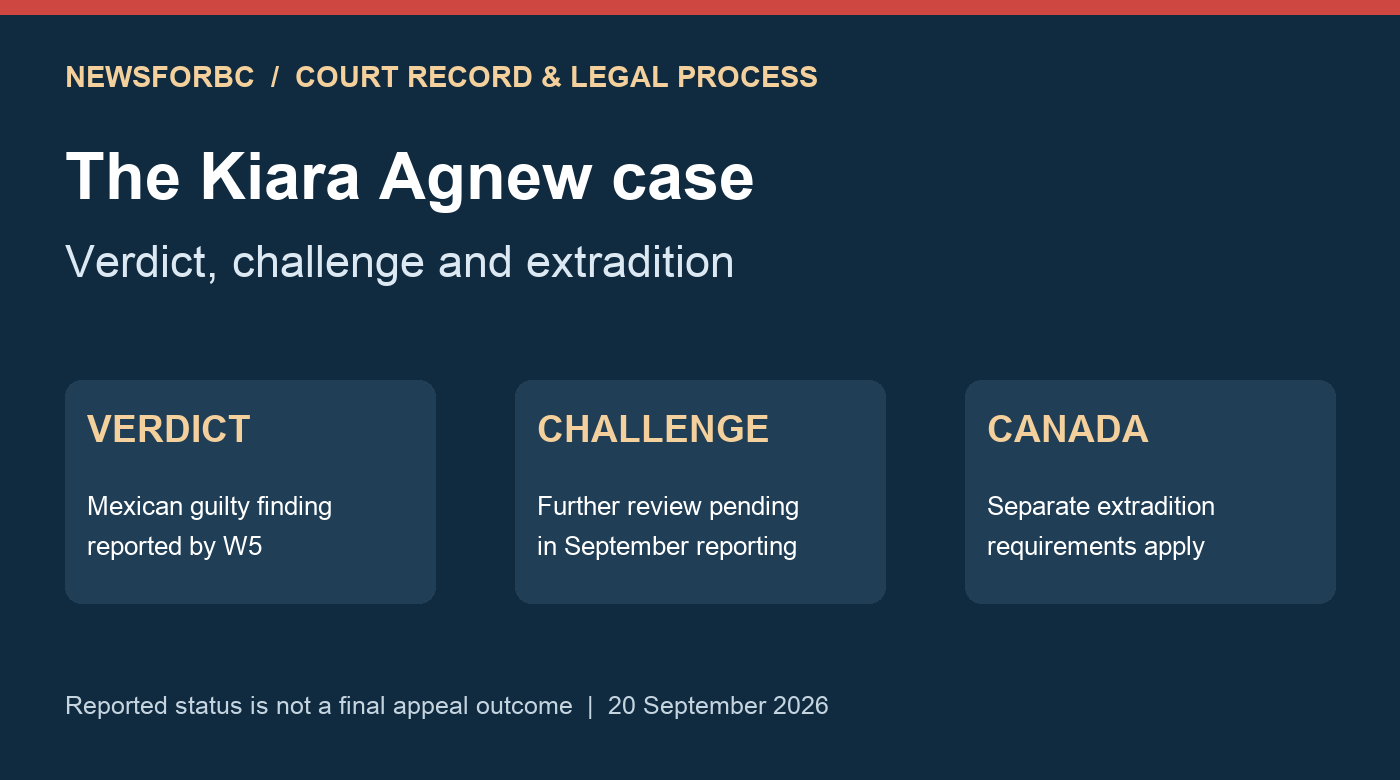
Published September 20, 2026. Latest case-status reporting reviewed: September 10, 2026. No later appeal ruling was verified in this research pass.
Ryan Friesen remained free in Canada while challenging a Mexican finding of guilt in the death of his girlfriend, Kiara Agnew, according to CTV W5 reports published September 8 and 10. The reports describe a femicide conviction that replaced an earlier acquittal, with a further legal challenge still unresolved at the time of reporting.[1][2]
The case raises a question that a warning flyer cannot answer on its own: what legal steps are required before a foreign conviction can lead to arrest and surrender from Canada? Justice Canada’s explanation makes clear that extradition involves a request, Canadian legal proceedings and a surrender decision—not automatic enforcement of another country’s verdict.[4][5]
What the reporting establishes
Agnew, a 23-year-old from Dawson Creek, died at a resort in Playa del Carmen, Mexico, in March 2023. Friesen was acquitted after a Mexican trial in September 2024 and returned to Canada, W5 reported.[1][3]
That was not the final development. W5 reported in January 2026 that a Mexican magistrate had declared Friesen guilty and that his lawyers were challenging the reversal through an amparo proceeding.[3]
The exact decision date needs care. The defence statement reproduced in W5’s January article places the reversal in mid-December 2025, while the article describes the family learning of it in January; September coverage summarizes the development as occurring in early 2026. Without the underlying dated judgment, this report does not assign the ruling a precise January date.[1][3]
W5’s September reporting continued to describe the conviction as under challenge. Friesen’s lawyer has maintained his innocence and disputed the case against him; that position is part of the record and should not be omitted from coverage.[1][2][3]
Evidence limit: NewsForBC has reviewed the reporting and the defence statement reproduced by CTV, not the complete Mexican trial and appellate records. This article does not independently reassess the forensic evidence or predict the appeal’s outcome.
Why a foreign conviction does not automatically mean Canadian imprisonment
Canada’s extradition framework permits surrender to an extradition partner for trial, imposition of a sentence or service of a sentence. Justice Canada says the conduct must satisfy the applicable dual-criminality requirement: it must be criminal in both countries.[4][5]
The general process has three stages: authorization to proceed, a judicial hearing on committal for extradition, and a personal decision by the federal justice minister on surrender. A person may appeal committal and seek judicial review of the surrender decision.[4][5]
There is also a provisional-arrest route. A foreign partner may request provisional arrest before submitting its full extradition package, subject to the applicable requirements and deadlines. It would therefore be too broad to say Canada can never act until every document in a formal request has arrived.[4]
Whether those mechanisms have been requested or are available on the present facts in Friesen’s case is a separate question. This research did not verify a Canadian arrest warrant, extradition committal or surrender order concerning him.
No public request does not necessarily mean no request
Justice Canada says communications between states in specific extradition cases are confidential and generally cannot be released publicly before an extradition arrest. Further disclosure can also be limited by a publication ban.[4]
That means an absence of a public announcement cannot, by itself, establish that Mexico has failed to request assistance or that Canadian officials have refused to act. Those are different claims requiring different evidence.
Nor would arrest necessarily settle detention for the duration of the proceedings. Justice Canada says an arrested person has an opportunity to apply for bail; whether release is granted is a judicial decision.[4]
W5’s September 10 account described possible extradition and a sentencing hearing in Mexico if the conviction survives and the Canadian process is completed. That is a reported possible route, not a confirmed transfer schedule or a sentence already imposed.[2]
The family’s demand for answers
W5 reported the family’s frustration with the wait and a petition seeking Friesen’s imprisonment. Those calls for accountability are part of the public story, but a petition does not itself resolve the appeal or supply a Canadian arrest order.[1][4][5]
The distinction matters: reporting a Mexican conviction under challenge does not require pretending it never happened, while reporting the family’s anger does not justify presenting a pending proceeding as complete.
The next useful records are the dated Mexican appellate reasons, the current amparo status or decision, any sentencing order, and any publicly releasable Canadian extradition proceedings. Until those records are available, claims about a final outcome, a Canadian release judge, a refusal to extradite or a fixed prison term would go beyond what this report verifies.
This report does not identify Friesen’s present address or invite readers to locate, approach or confront him. Accountability belongs in verifiable records and lawful proceedings, not a public search for a person.
“Kiara’s Law”: a petition, not an enacted law
A separate parliamentary initiative should not be confused with the imprisonment petition reported by W5. The official House of Commons record identifies e-7071, presentation number 451-00854, as a petition initiated by Tanya Agnew and presented by Ziad Aboultaif on April 17, 2026. A government response was tabled June 1.[6]
It asks for legislation called “Kiara’s Law” concerning Canadian forensic autopsies after suspicious deaths abroad, enhanced consular advocacy and Canadian criminal jurisdiction where one Canadian harms or kills another outside Canada. The petition and government response do not establish that those requested changes have become law.[6]
The response says Canada cannot compel foreign authorities to conduct or permit a Canadian-led autopsy. It describes existing consular assistance and jurisdictional limits; it is not a case-specific extradition decision or a new power to imprison Friesen.[6]
Editorial and source notes
- Social lead: The supplied Facebook post resolves to a post in “Justice for Kiara: Trevor Agnew.” Public metadata says the flyers were received in the Lower Mainland. The captured photograph shows printed warnings naming Friesen and Agnew. Neither the breadth of distribution nor Friesen’s current location is established by that post. The image is retained privately and is not reproduced in this report.
- Status check: The latest directly reviewed case-specific reports were W5’s September 8 and 10 articles. A bounded search did not verify a subsequent appeal decision; this is not a registry-wide clearance.
- Sentence caution: The January and September reports contain different descriptions of possible sentencing exposure. No numerical range is adopted without the applicable primary legal record.
- Court monitoring: Judge identities and the Mexican file number remain unverified in this report. No Canadian bail/release judge has been identified, and none should be inferred from the fact that Friesen is in Canada. Source-trail only; no judicial-misconduct finding.
- Reporting method: Public-source research only. No interviews, contact with the family or defence, registry certification, or outreach undertaken. Full CTV article content was recovered from the publisher’s embedded article data after the text extractor omitted the body.
Sources
- [1] CTV W5 September 8
- [2] CTV W5 September 10 extradition explainer
- [3] CTV W5 January report and defence statement
- [4] Justice Canada: Extradition overview
- [5] Justice Canada: Extradition requests
- [6] House of Commons: e-7071 and government response
Source package: Editorial source note · Evidence table · Court monitoring record.