Evidence note: This story separates the official BC Parks advisory, the Líl̓wat Nation statement, and the legal argument reported by Western Standard/JCCF. No court decision or filed court challenge was found during this source check.
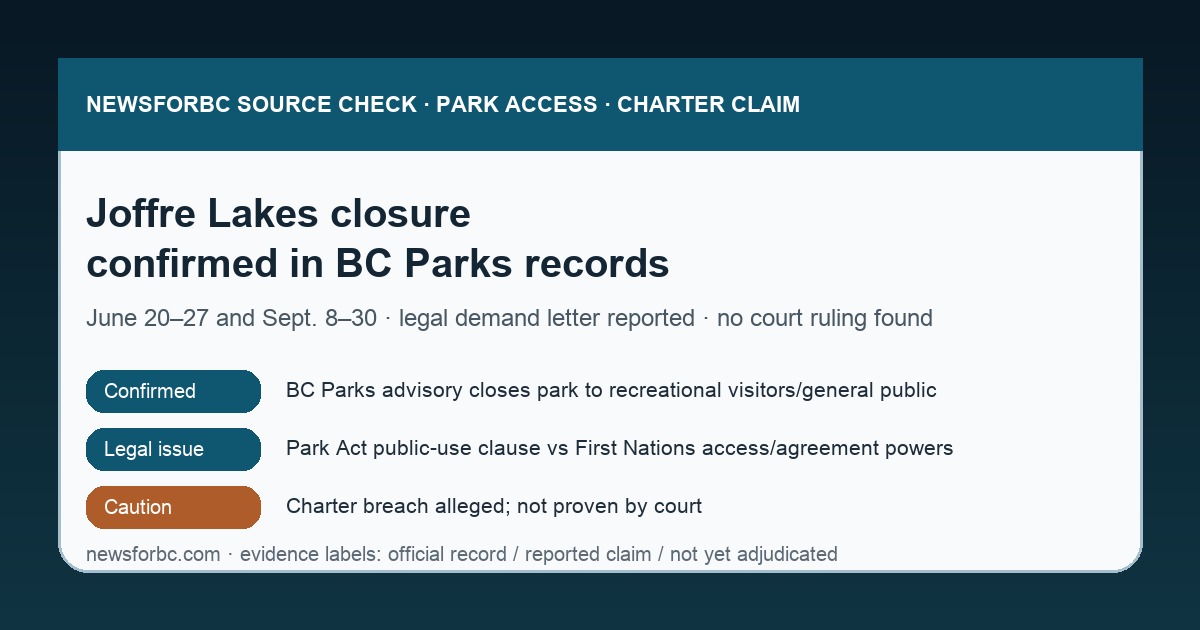
What is actually confirmed
BC Parks’ public-advisories API confirms an advisory titled “Park closed to recreational visitors June 20 to 27 and September 8 to 30, 2026.” The advisory says the park will be closed to recreational visitors and the general public during those periods to recognize the importance of Pipi7íyekw/Joffre Lakes Park to the Líl̓wat Nation and N’Quatqua and to provide space for the Nations to connect with the land.
The same advisory says day-use passes are not available during those periods. Another BC Parks advisory says day-use passes are required daily from May 11 to Oct. 25, 2026, outside the closure periods.
BC Parks’ day-use page says the park is managed for 500 visitors per day, partly to let the park recover from years of overuse and to improve solitude and visitor experience.
What the viral post adds
The Instagram post by Property Rights Canada says B.C. is turning away provincial park visitors “based on ancestry” and quotes lawyer Marty Moore arguing the closure may violate provincial law and the Charter. The post is based on a wider legal challenge narrative reported by Western Standard.
Western Standard reports that the Justice Centre for Constitutional Freedoms announced lawyers it is funding sent a legal demand letter to B.C. seeking cancellation of the closures. Western Standard quotes Moore saying B.C. is obligated to manage parks for public use and enjoyment and that there is no indication the province considered the constitutional rights of the public.
Important legal-status caveat
NewsForBC did not find a public court filing or court decision. The legal position is a demand-letter / threatened-litigation argument, not a ruling that the closure is unlawful.
The Park Act cuts both ways
The legal argument against the closure starts with the Park Act. The Act says Class A parks are dedicated to preserving natural environments for the “inspiration, use and enjoyment of the public.” That supports the public-access side of the debate.
But the same Act also gives the minister jurisdiction over public and private use/conduct in parks and allows the minister to enter agreements with First Nations about activities necessary for the exercise of Aboriginal rights and access for social, ceremonial and cultural purposes. That supports the province’s ability to make room for First Nations use in at least some circumstances.
So the hard question is not whether the public has an interest in access. It does. The harder question is whether a full 31-day closure to recreational visitors is authorized, proportionate and constitutionally defensible.
The Charter argument
The reported legal challenge points to Charter sections 6 and 15. Section 15 protects equality before and under the law and equal protection and benefit of the law without discrimination, including discrimination based on race or national/ethnic origin.
Section 6 protects mobility rights: the right of Canadian citizens to enter, remain in and leave Canada, and rights to move to and live/work in any province. Whether a temporary provincial park closure is really a section 6 mobility-rights issue is a legal question a court would have to test. Section 15 is the more obvious equality-rights frame, but it also would face government defences.
Those defences could include Charter section 1 reasonable limits, Charter section 25’s protection of Aboriginal/treaty/other rights from being abrogated or derogated by Charter interpretation, section 35 Aboriginal rights, the Park Act’s First Nations agreement clause, DRIPA, reconciliation policy and conservation/overuse management.
The Indigenous-rights context
BC Parks says the area between North Joffre Creek and Cayoosh Pass is known as Pipi7íyekw, meaning a camping place where storage houses were, in the St̓átimcets language. BC Parks also quotes Líl̓wat leadership saying the park lies within the unceded territories of Líl̓wat Nation and N’Quatqua and is integral to who they are.
Líl̓wat Nation has published a statement to its members saying leadership is aware of letters, public commentary and media coverage about public access to Pipi7íyekw. The statement says the Nation will not entertain narratives rooted in racism, prejudice or misunderstanding of who Líl̓wat people are and of their inherent rights. It describes Líl̓wat people as original and ongoing caretakers of Pipi7íyekw.
BC Parks’ day-use exemption page separately says First Nations whose traditional territories overlap a day-use pass park do not need a pass to enter, and that BC Parks supports constitutionally protected Aboriginal Rights in parks and protected areas in keeping with DRIPA.
The accountability problem
The closure is not just a culture-war talking point. It raises legitimate governance questions: What agreement authorizes the closure? Was a public decision document issued? Why 31 days? Why those dates? What alternatives were considered? Did B.C. assess Charter impacts? Did it consider partial closures, timed access, zones, ceremony-specific restrictions or day-use quotas instead?
Those questions can be asked without repeating racist comments or denying Indigenous title and rights. The public owns a real access interest in a Class A park. Líl̓wat Nation and N’Quatqua hold real rights, history and stewardship claims in Pipi7íyekw. B.C.’s job is to show how it balanced those interests in law.
What is confirmed, reported and not yet proven
- Confirmed by BC Parks: recreational visitors and the general public are excluded June 20–27 and Sept. 8–30, 2026.
- Confirmed by BC Parks: day-use passes are not available during those periods.
- Confirmed by BC Parks: the reason given is to recognize the importance of Pipi7íyekw/Joffre Lakes to Líl̓wat Nation and N’Quatqua and provide space to connect with the land.
- Confirmed by law: the Park Act contains both a public-use purpose for Class A parks and a First Nations agreement/access provision.
- Reported by Western Standard/JCCF: lawyers funded by JCCF sent a legal demand letter alleging Charter and Park Act problems.
- Stated by Líl̓wat Nation: public narratives rooted in racism or misunderstanding are harmful and the Nation remains responsible for caring for Pipi7íyekw.
- Not found: a filed court challenge, injunction application, judge’s ruling, or full original legal demand letter.
- Not proven: that the closure is unconstitutional, or that every public-access objection is racist.