NewsForBC Saturday feature · Canadian economy · Housing
Home equity tax warning: Evan Siddall, Build Canada Homes and the fight over Canadians’ principal residences
A Saturday feature/source-check on Tap the Maple’s home-equity-tax warning, Evan Siddall’s housing record, Generation Squeeze/CMHC report trail, Canadian-dollar decline, inflation and why taxing principal-residence equity should be a political no-go.
A new Tap the Maple video argues that Canadians should pay attention to Evan Siddall’s return to federal housing power because Siddall’s CMHC-era record overlaps with a publicly funded Generation Squeeze/CMHC lab that recommended an annual, deferrable surtax on high-value principal residences. The warning is not that a home-equity tax is already law. The warning is that the policy ecosystem has already written the blueprint — and Canadians should say no before it becomes a budget line.
What triggered the story
The source video, “Canadians Home Equity AT RISK! Carney’s DANGEROUS Appointment Should Terrify You!”, was posted by Tap the Maple / Bakes on Things. Its description says Mark Carney appointed former CMHC CEO Evan Siddall as the inaugural chair of Build Canada Homes and argues that Siddall’s earlier speeches, CMHC record and Generation Squeeze-linked material raise questions about the future of the principal residence exemption.
The most important correction is spelling and evidence labels. The auto-transcript repeatedly renders the name as “Siddle,” but the public figure is Evan Siddall. The article below treats the video as a warning/commentary lead, then checks the record behind it.
Who is Evan Siddall?

Siddall is not a random housing administrator. His public biography records him as a former Special Advisor to the Governor of the Bank of Canada, former President and CEO of Canada Mortgage and Housing Corporation from 2014 to 2021, and later CEO of the Alberta Investment Management Corporation. That background matters because housing policy is not only about building units. It is also about credit, mortgage insurance, asset values, public finance, household leverage and who gets protected when policy mistakes collide with family balance sheets.
The video’s political point is that Siddall and Carney are not strangers in the policy world. The public biography/source trail places Siddall at the Bank of Canada before CMHC, and the video says Carney’s government has now put him at the top of Build Canada Homes. Because the Prime Minister’s site search did not produce an official search result in this pass, this article labels the appointment detail as video-description/source-lead plus current public-policy claim and flags the official appointment page as a record still wanted for the source package.
The CMHC speech that matters
In April 2018, while president and CEO of CMHC, Siddall delivered a speech titled “Too Much of a Good Thing: On Housing, Wealth and Intergenerational Inequity.” The recovered CMHC page says Siddall opened with a personal example about his 76-year-old mother living alone in a large three-bedroom Toronto-area home — more housing than she needed, in his framing — while working families needed space.
The same CMHC speech says principal residences accounted for $4.3 trillion of Canadians’ assets, and it describes housing as a primary means of building wealth and financial security. It also says tax-free gains and low interest rates make investing in homes an “irresistible means of savings,” and that a home’s value can increase ten-fold or more without triggering capital gains tax. That is not a tax bill. But it is the philosophical foundation for asking whether home equity is being treated too favourably.
That is where the public should be alert. The leap from “homeowners built wealth” to “government should tax the shelter” is the line that must be fought before it hardens into policy.
The report trail: CMHC, Generation Squeeze and a surtax recommendation
The strongest source is not a rumour. It is a CMHC-linked project profile and the Generation Squeeze final report. CMHC’s project page for Wealth and Generational Inequity in Canadian Housing describes a Solutions Lab that hypothesized many Canadians are “entangled or incentivized by public policies to bank on profits from homeownership.” It says the project would examine policy categories including monetary and lending policy, tax policy and protective policy, and that the final report would propose policy prototypes. CMHC’s page also states there was no obligation for any government to adopt proposed solutions.
The Generation Squeeze PDF is more explicit. Its executive summary says one tax-policy recommendation was to implement an annual, deferrable, progressive surtax on the 9% of homes in Canada valued at over $1 million to reduce the “tax shelter” on principal residences. The report says deferrable means the tax would not need to be paid until the home was sold or inherited, with interest charged on the deferred amount.
That wording is the policy payload. Even if only a minority of homes are hit at first, the principle changes once Ottawa or a province decides your home equity is a taxable reservoir. Thresholds move. “Only the rich” becomes “only the upper middle class,” then “only above average,” especially in markets where a modest family home can cross $1 million because the currency weakened, land supply was constrained, interest-rate policy distorted prices, immigration/household formation outpaced housing supply, and governments failed to build infrastructure properly.
Why a million-dollar home is not a millionaire lifestyle
A million-dollar home in Vancouver, Victoria, the Lower Mainland, Toronto, or even parts of smaller B.C. markets is not proof that the owner has spare cash. It may be a family that bought decades ago, paid taxes every year, carried a mortgage through recessions, raised children, deferred repairs, and now holds one asset that could help kids or grandkids survive the same economy government made harder.
That is the moral issue. If mom can sell her home for $1 million and use the proceeds to support children who were priced out, laid off, displaced by automation, or crushed by cost-of-living inflation, that should be her family’s recovery valve — not Ottawa’s next revenue experiment.
Taxing a principal residence after a lifetime of already-taxed earnings would punish patience. It would punish families that did the old civic bargain: work, save, buy, maintain, pay property tax, pay income tax, pay GST/HST/PST, and hope the home can become retirement security or intergenerational support. Calling that “unearned wealth” ignores the lived ledger.
The dollar chart: not all “home gains” are real gains
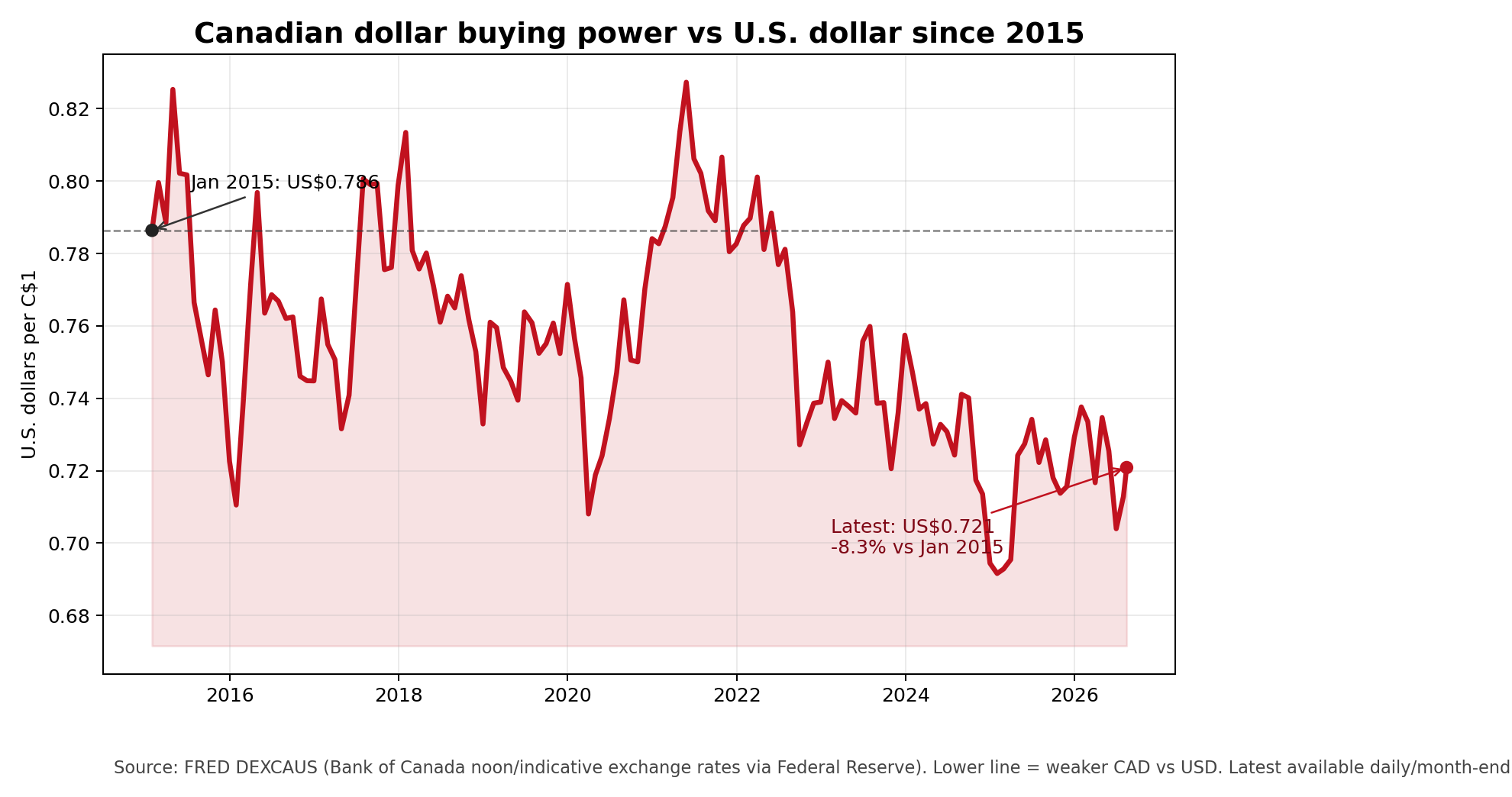
The chart below uses FRED’s DEXCAUS series, Canadian dollars per U.S. dollar. Converted into U.S. dollars per Canadian dollar, it shows the currency side of the story. The latest available datapoint in the saved dataset is 2026-08-14: C$1 bought about US$0.721. The strongest 2015 reading in the same dataset was 2015-01-02: about US$0.853. That is a decline of about 15.5% from that 2015 high.
Important honesty: the data does not support a simple “25% drop since Jan. 2015” line. The stronger factual point is that the Canadian dollar is weaker than its early-2015 level, and the saved CPI series shows Canadian consumer prices up about 28.2% from January 2015 to the latest available CPI datapoint in that FRED/OECD file. So a nominal million-dollar sale is not a million dollars of 2015 purchasing power. Inflation and currency decline eat the number before any politician touches it.
The no-go line
The correct public answer is simple: build housing, fix permitting, remove bottlenecks, stop wasting public money, stop treating foreign-policy adventures as more urgent than Canadian households, and stop looking at private home equity as a cash drawer.
Governments mismanaged supply. Governments inflated costs. Governments layered taxes and fees into land, construction, energy, transportation and food. Governments presided over a dollar that buys less, while households were told to be responsible and save. Now the same political class should not be allowed to say the only remaining family asset is “undertaxed.”
If policy makers want fairness between generations, they should start by making wages, productivity, housing supply and the Canadian dollar stronger — not by clawing back the one asset many parents hoped to use to help their children.
What other media and source trails are saying
The immediate media lead is the Tap the Maple video, which had tens of thousands of views when captured. Related Canadian commentary channels shown around the video were discussing the same larger stressors: food inflation, retirement insecurity, trade uncertainty, housing and the Canadian economy. The deeper policy trail comes from CMHC and Generation Squeeze rather than a single mainstream news headline: a CMHC project profile, a CMHC Solutions Lab program page, Siddall’s CMHC speech, Generation Squeeze’s housing-wealth pages, and the Generation Squeeze final report PDF.
That is enough for a serious warning. It is not enough to say a home-equity tax has been officially tabled by the current government. The clean formulation is: the policy architecture exists, the language exists, the personnel history exists, and homeowners should demand a written commitment that principal-residence equity will not be taxed.
Questions every MP should answer
- Will the federal government commit in writing that it will not tax gains on principal residences?
- Will Build Canada Homes publish any advice it receives about home equity, principal-residence tax treatment or surtax proposals?
- Will CMHC disclose all Solutions Lab funding, reports, participants and implementation follow-up related to housing wealth and generational inequity?
- Will federal housing policy focus on supply, approvals, infrastructure, productivity and currency/inflation damage before looking at household assets?
- Will MPs protect parents and grandparents who want to use home proceeds to support children hurt by job loss, automation, inflation and unaffordable rent?
Bottom line
A principal residence is not Ottawa’s piggy bank. The country does not become fairer by making family rescue capital taxable after government helped create the affordability crisis. Home-equity-tax language should be treated as a warning flare: once bureaucrats and policy labs normalize the idea, Canadians need to shut it down before it becomes “responsible tax reform.”
The answer should be blunt: No home equity tax. No principal-residence surtax. No inheritance-time clawback disguised as fairness. Build homes, protect families, and stop raiding Canadians for mistakes made by government.