Editorial note: This article is public-interest legal literacy, not legal advice. Anyone dealing with CRA enforcement, audit, charges or collections should speak with a qualified tax lawyer or criminal-defence lawyer.
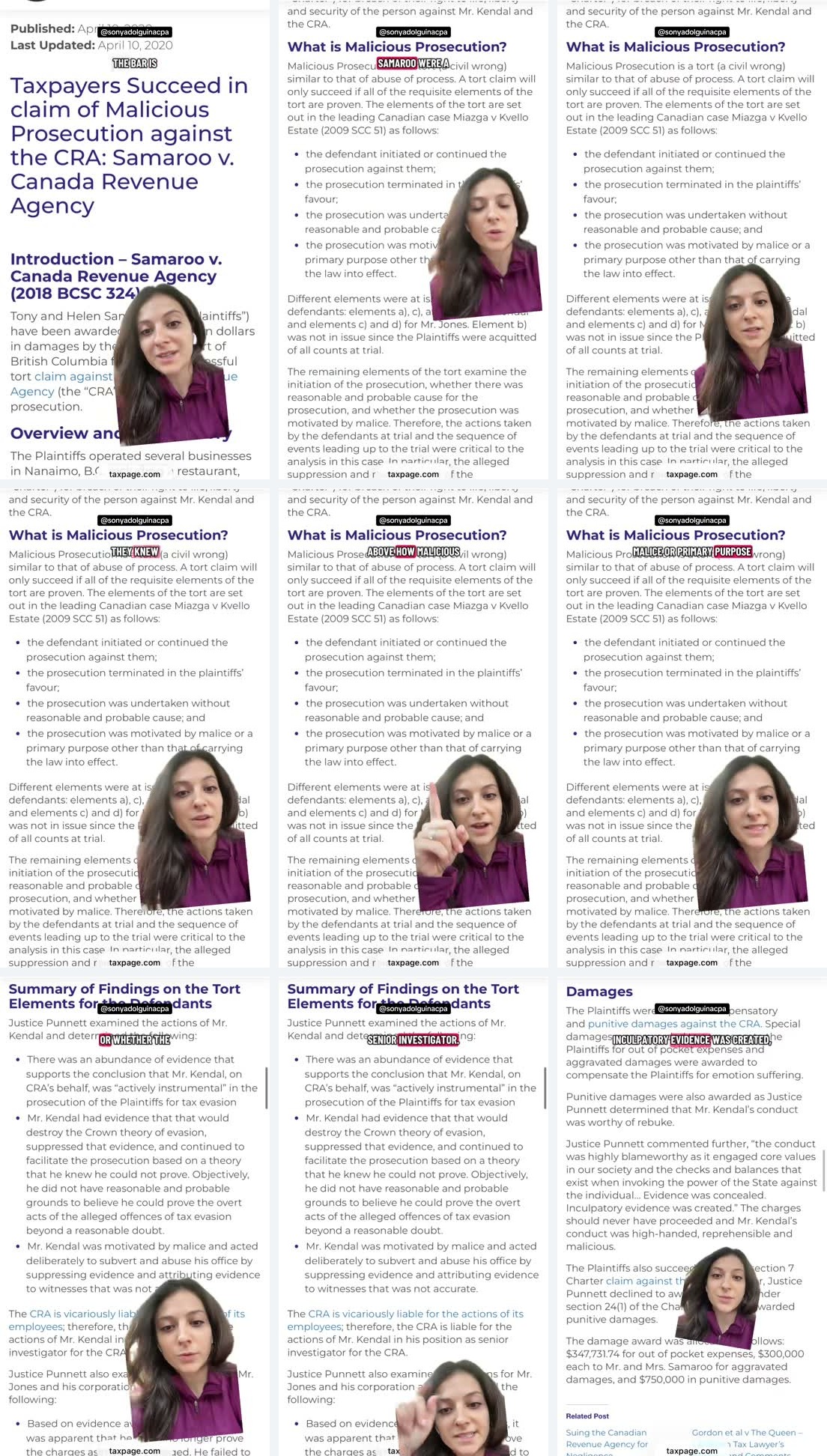
A TikTok by CPA creator Sonya Dolguina asks a sharp question: can a taxpayer sue the Canada Revenue Agency for emotional distress or malicious conduct? The video points to a B.C. case involving Nanaimo taxpayers Tony and Helen Samaroo, who were reportedly awarded roughly $1.6 million after a failed CRA tax-evasion prosecution.
The short answer is: yes, a lawsuit against tax authorities can be possible in extreme facts. The longer answer is that malicious prosecution is a high-bar claim. It is not a remedy for every audit dispute, reassessment, collection fight or painful interaction with government.
What the TikTok says
The video says the couple ran multiple businesses in Nanaimo, were accused by CRA of tax evasion, were cleared of criminal charges, then sued for malicious prosecution. It says CRA ignored evidence that would have hurt its own case, pushed ahead with criminal prosecution, and was found liable because of the conduct of a senior investigator.
The transcript says the court described conduct as high-handed, reprehensible and malicious, and says the couple received damages shown in the video. NewsForBC captured the TikTok transcript and metadata and preserved a contact sheet of the clip.
The real B.C. case behind the clip
The apparent case is Samaroo v. Canada Revenue Agency, 2018 BCSC 324, a B.C. Supreme Court decision available through CanLII. During NewsForBC capture, CanLII was CAPTCHA-blocked, so this article does not pretend to be a full legal memo based on a fresh read of the entire judgment. However, the case title/citation and legal-reporting trail support the core point: this was a real CRA malicious-prosecution case out of British Columbia.
Canadian Accountant indexed the story under the headline “The Samaroo Case: CRA slapped for malicious prosecution by BC Supreme Court.” The TikTok’s “Tony and Helen Sam” appears to be a shorthand or transcript error for the Samaroo taxpayers.
What malicious prosecution usually requires
In Canadian law, malicious prosecution is not just “the government was wrong.” The usual elements include that a prosecution was initiated, it ended in the plaintiff’s favour, there was no reasonable and probable cause, and the prosecution was motivated by malice or an improper purpose.
That is why the TikTok is right to say the bar is high. A person can be hurt badly by a government process and still not meet the legal test. The difference is between an error, an aggressive enforcement position, and a prosecution allegedly pursued without reasonable cause and for an improper purpose.
Why it matters in B.C.
For B.C. small-business owners, contractors and family-run companies, CRA enforcement can be frightening even when a person believes they have records and explanations. Criminal tax charges are not the same as a normal reassessment. They can damage reputations, businesses, banking relationships and family life long before a court gives a final answer.
The Samaroo case is therefore useful as a civic lesson. It does not mean taxpayers can casually sue CRA and win. It does mean that tax enforcement powers are not above scrutiny when the facts are exceptional and a court finds the legal test is met.
What readers should not take from this
Do not treat this as a template for ignoring CRA, refusing records, or assuming every tax dispute is malicious. Most tax disagreements belong in normal objection, appeal, Tax Court, settlement or professional-resolution channels.
Do treat it as a reminder to preserve records, get qualified advice early, distinguish civil tax disputes from criminal investigations, and document important conversations. If CRA action moves toward criminal allegations, the next call should be to a lawyer, not to TikTok.
Evidence labels
- Confirmed: The TikTok exists and claims a B.C. couple won damages after a CRA malicious-prosecution case.
- Supported: The relevant case appears to be Samaroo v. Canada Revenue Agency, 2018 BCSC 324.
- Supported: The case has been described by Canadian Accountant as a B.C. Supreme Court malicious-prosecution ruling against CRA.
- Caution: CanLII was CAPTCHA-blocked during this capture, so exact judgment quotations should be verified directly before use in a legal brief.
- Caution: The result is exceptional; it does not make ordinary audit or assessment disputes into malicious-prosecution lawsuits.
Source trail
- TikTok by @sonyadolguinacpa: “Can you sue the CRA…”.
- CanLII citation: Samaroo v. Canada Revenue Agency, 2018 BCSC 324.
- NewsForBC source note and capture caveats.
- Captured TikTok transcript.
NewsForBC view: the public-interest lesson is not anti-tax rage. It is accountability. Tax agencies need real enforcement power, but when criminal prosecution is pursued, the standard of fairness must be high enough that ordinary Canadians can trust the system.