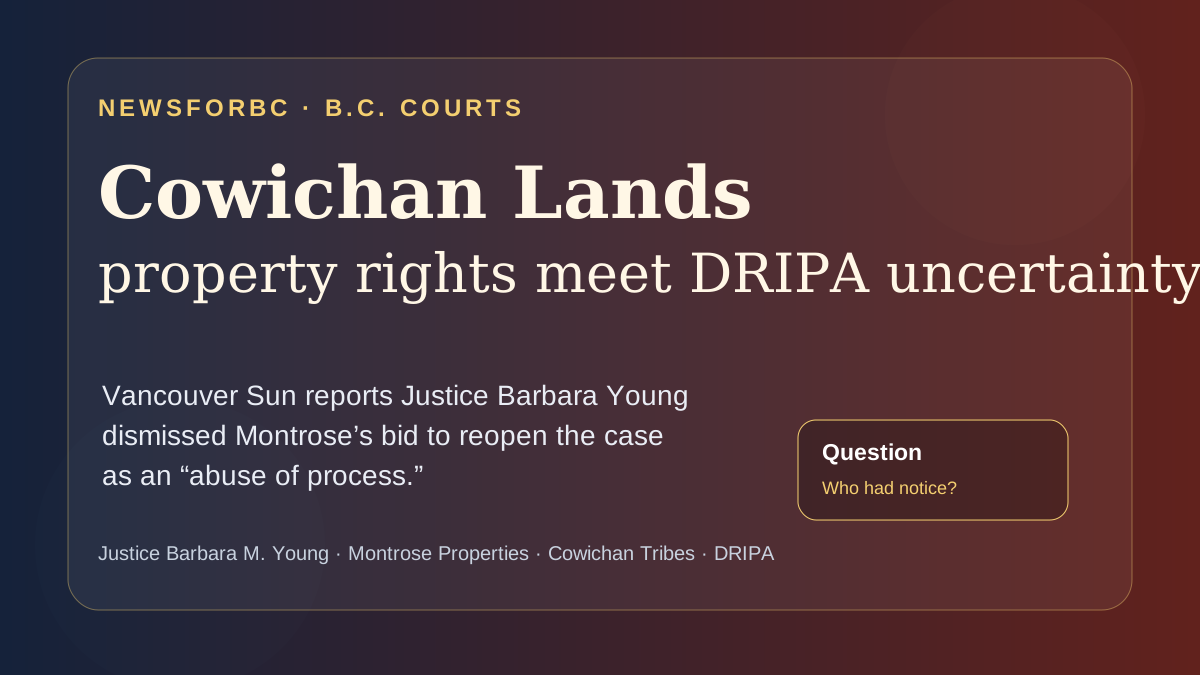
Cowichan lands, Justice Barbara Young and the DRIPA property-rights collision
The Vancouver Sun reports a B.C. judge has thrown out Montrose’s bid to reopen the Cowichan lands decision. The judge who made the decision: Justice Barbara M. Young.
Source status
Reported by Vancouver Sun/Postmedia: In a June 29, 2026 story by Gordon Hoekstra, the Sun says B.C. Supreme Court Justice Barbara Young dismissed Montrose’s application to reopen/re-litigate the Cowichan Aboriginal-title case as an “abuse of process.”
What NewsForBC has not yet independently captured: the official B.C. Courts URL/citation for the new June 29 reopening decision. Until that is located, the new dismissal is attributed to the Vancouver Sun report, while the underlying case is identified through the public case trail as Cowichan Tribes v. Canada (Attorney General), 2025 BCSC 1490.
The Vancouver Sun story identifies the judge as Justice Barbara M. Young of the B.C. Supreme Court.
Young is the judge associated with the underlying 2025 Cowichan lands ruling and, according to the Vancouver Sun’s June 29 report, the judge who dismissed Montrose’s bid to reopen the matter.
This is not an allegation of corruption or improper motive. The public-interest issue is the decision’s practical effect: reasoning, notice, who had standing, who did not, and how far a private landowner must go to be heard when a court ruling clouds land they own.
What the Sun says happened
The Sun reports that the application was brought by the Montrose companies, described as owning warehouses, a Coca-Cola distribution centre and other facilities in the Richmond area covered by the Cowichan title ruling.
The article says Montrose was not involved in the original trial but argued its property and financial interests were directly and significantly affected. It also reports the company said one potential deal had been put on hold.
Young, according to the Sun, said the proper place for Montrose to make its case is through an appeal. The Sun quotes the decision as saying Montrose had knowledge of the proceedings and waited until long after trial to seek party status.
The public problem
This case is not just a procedural argument between lawyers. It touches the basic civic expectation that if a court case can materially affect private land, owners get a meaningful chance to be heard before the damage is done.
The court’s answer, as reported, is procedural finality: reopening after trial risks a sprawling, inefficient process and incentives for late intervention. The landowner answer is procedural fairness: if the ruling reaches privately owned land, affected owners cannot be treated as spectators.
Both concerns are real. But for citizens, lenders and businesses, the visible outcome is uncertainty.
Evidence labels
Confirmed / reported: Vancouver Sun reports Justice Barbara Young dismissed Montrose’s reopening application as abuse of process.
Confirmed / official: B.C.’s DRIPA page says the Declaration Act is B.C.’s reconciliation framework and aims for transparency and predictability.
Confirmed / public case trail: the underlying Cowichan case is widely identified as Cowichan Tribes v. Canada (Attorney General), 2025 BCSC 1490, Justice Barbara M. Young.
Not yet captured: official URL/citation for the June 29, 2026 reopening dismissal.
Not alleged: NewsForBC is not alleging improper motive by the judge.
Public comment: DRIPA’s promise meets property-title uncertainty
B.C.’s official DRIPA page says the Declaration Act aims to respect Indigenous human rights while creating “better transparency and predictability” in the work government does with Indigenous Peoples.
That promise is now being stress-tested in Richmond. If a reconciliation framework produces a result where private owners, lenders and businesses cannot tell what their land title means in practice, the Province has a political and legal problem bigger than one case.
DRIPA was sold as a framework for reconciliation. It cannot become a fog machine for property rights. Reconciliation requires honesty with Indigenous Nations, but also honesty with families, farmers, businesses, lenders and municipalities who have been told for generations that registered title means something stable.
The Province should stop hiding behind litigation posture and publish a plain-language map of what is affected, what is not, what compensation pathway is contemplated, what homeowners can rely on, and how future title litigation will notify affected private owners before judgment — not after.
Questions NewsForBC will keep asking
When will the official June 29 decision be publicly linked and what is its neutral citation?
What exact notice did Montrose and other private owners have before the original trial concluded?
How many private owners, lenders, tenants and businesses are affected by the Cowichan title area?
What does “coexistence” between Aboriginal title and private title mean for financing, insurance, sale and redevelopment?
What is B.C.’s DRIPA implementation plan for private-title uncertainty?
Will the Province create a compensation or title-assurance framework before appeals finish?
Bottom line
Justice Barbara Young’s decision matters because this case has moved beyond abstract reconciliation language into the practical confidence of B.C. land title.
The courtroom may see a late application. The public sees something larger: people who own land being told the proper place to fight is somewhere else, after a ruling has already changed the risk attached to their property.
If DRIPA and Aboriginal-title law are going to reshape private-property expectations in British Columbia, the Province owes citizens transparency before the shock hits their title, mortgage or business deal.
Update · X video · 2026-08-16
Peter MacIsaac / Jim Ferguson X clip: China-sale warning needs legal precision
Short answer: the video is real and points to a real Cowichan Aboriginal-title/property-rights controversy. But the claim that the land could simply be sold to China is not established by the judgment. Aboriginal title is communal and inalienable except to the Crown.
Claim
Finding
“Nothing to stop them selling that land to China.”
Unsupported/legal overstatement. The judgment discusses Aboriginal title, fee simple conflicts and Crown negotiation duties; Aboriginal title doctrine says it is inalienable except to the Crown.
Prime real estate/warehouses/factories are affected.
The claim area is in Richmond/Lulu Island and includes Crown, VFPA, Richmond and private interests. The decision is serious for property-rights policy.
Fentanyl/organized crime is disrupting the economy.
Real public-policy concern, but not proof that Aboriginal-title land will be sold to foreign criminal interests.