
National law · firearms · Supreme Court of Canada · B.C. civil liberties angle
CCFR firearms-ban case reaches Supreme Court: what the “12 to 1” intervener Reel gets right — and what it overstates
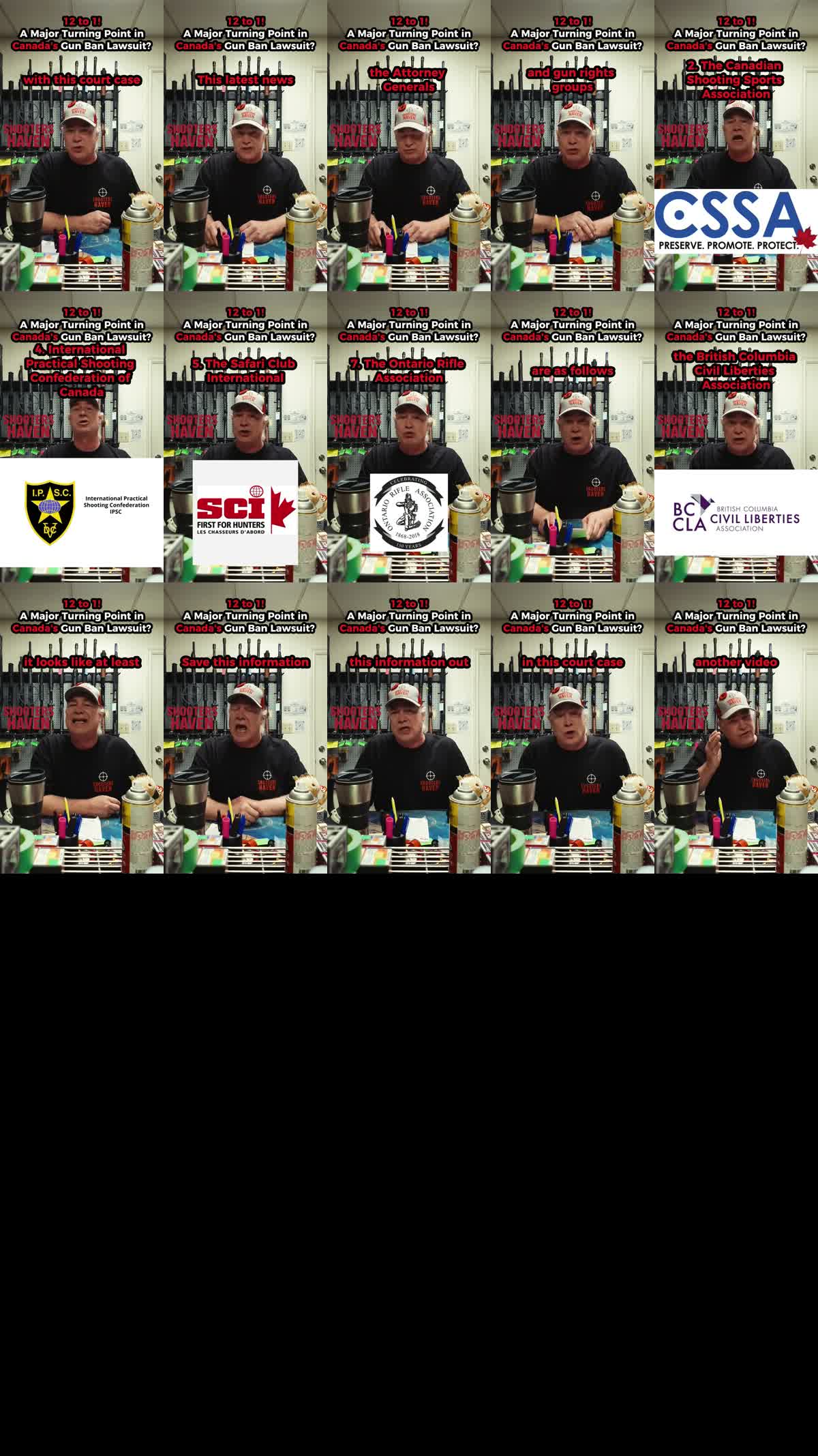
A Shooters Haven Instagram Reel says the CCFR firearms-ban case has a “12 to 1” turning-point lineup of interveners. The important part is real: the Supreme Court of Canada is hearing the case and multiple governments and organizations have intervened. The number is not a court result.
Captured source: Instagram Reel DbZNnmJBg29 from Shooters Haven / @shootershavenyeg. NewsForBC preserved the MP4, metadata, thumbnail, frame sheet and extraction log.
What the Supreme Court docket says
The case is Canadian Coalition for Firearm Rights, et al. v. Attorney General of Canada, SCC file 41859. The SCC says the May 1, 2020 regulations, SOR/2020-96, effectively prohibited more than 1,500 firearms that had previously been legal for licensed ownership and use. The applications for judicial review were dismissed by the Federal Court; four appeals were consolidated and dismissed by the Federal Court of Appeal; the SCC granted leave on March 19, 2026.
The SCC summary says the appeal raises administrative-law, subordinate-legislation, firearms, vires and Charter section 7 questions, including the scope of cabinet’s power under Criminal Code section 117.15 and the clarity of undefined “variant” language.
The interveners NewsForBC found
The SCC docket for 41859 lists these active interveners:
- Attorney General for Saskatchewan
- Attorney General of Alberta
- Attorney General of Ontario
- Canadian Constitution Foundation
- Canadian Shooting Sports Association
- International Practical Shooting Confederation Canada
- Safari Club International
- Canadian Coalition for Gun Control
- British Columbia Civil Liberties Association
- Ontario Rifle Association
- Canada’s National Firearms Association
The Aug. 13, 2026 intervention order also says the Canadian Taxpayers Federation motion was dismissed. The order grants factum and oral-argument time to interveners but warns that interveners are not entitled to express a position on the appeal’s disposition, raise new issues, add evidence, supplement the record or duplicate other submissions.
Why the “12 to 1” framing needs care
There is clearly an imbalance in the public lineup of organizations: most listed interveners appear to be provincial governments, firearms/sporting/hunting groups, or civil-liberties/rule-of-law groups, while the Canadian Coalition for Gun Control is the obvious gun-control intervener. But the Supreme Court does not decide cases by counting interveners, and groups such as the BCCLA or CCF may focus on legal standards rather than simply “supporting gun owners” as a political side.
So the careful wording is: many interveners are participating in a case that challenges Ottawa’s firearms regulations; that is significant, but it is not a merits ruling.
What the lower courts did
CBC reported that the Federal Court dismissed the challenge in 2023 and that the Federal Court of Appeal agreed in 2025. The challengers argue cabinet exceeded its delegated authority and that undefined variant language creates criminal-law uncertainty. The federal government argues the ban is within Parliament’s limits and supports public safety.
Public Safety Canada said in June 2026 that the amnesty orders for 2020, 2024 and 2025 prohibitions have been extended to 90 days after the SCC renders its decision, expected next year. The government also said the compensation program continues and remains the only opportunity for compensation.
Claim-by-claim check
| Claim | Status |
|---|---|
| The CCFR firearms-ban case is before the Supreme Court of Canada. | Confirmed. SCC docket 41859 is active and leave was granted March 19, 2026. |
| Alberta, Saskatchewan and Ontario are intervening. | Confirmed. The SCC docket lists all three Attorneys General as active interveners. |
| There are 13 new interveners / “12 to 1.” | Needs precision. SCC docket 41859 lists 11 active interveners. One motion by the Canadian Taxpayers Federation was dismissed. “12 to 1” is not a formal court count or outcome. |
| Only one side supports the federal ban. | Advocacy shorthand. Canadian Coalition for Gun Control is the obvious gun-control intervener, but civil-liberties/legal-standard interveners should not automatically be counted as political gun-rights votes. |
| The lower courts struck down the ban. | False. The Federal Court and Federal Court of Appeal dismissed the challenges. |
| The amnesty was extended because of the SCC process. | Confirmed. Public Safety Canada says the amnesty orders are extended until 90 days after the SCC decision. |
Why B.C. readers may care
The case is national, but B.C. has a direct civil-liberties hook: the British Columbia Civil Liberties Association is an active intervener. The case also affects licensed firearms owners, sport shooters, hunters, clubs, retailers and public-safety policy debates across B.C.
Sources
- Supreme Court of Canada docket 41859.
- Canadian Constitution Foundation intervention release.
- CBC: Canada’s top court will hear challenges to Liberals’ firearms ban.
- Public Safety Canada amnesty-extension release.
- CCFR Supreme Court factum page.

.jpg)