Evidence note: This article uses Health Canada’s official annual MAID report for the growth statistics. The Facebook video is treated as a lead and commentary source, not as proof by itself. This is public-interest reporting, not medical or legal advice.
Download the shareable stats PDF
NewsForBC has attached a printable three-page PDF infographic showing the official 2019–2024 MAID growth chart, a claim-check table and a source trail.
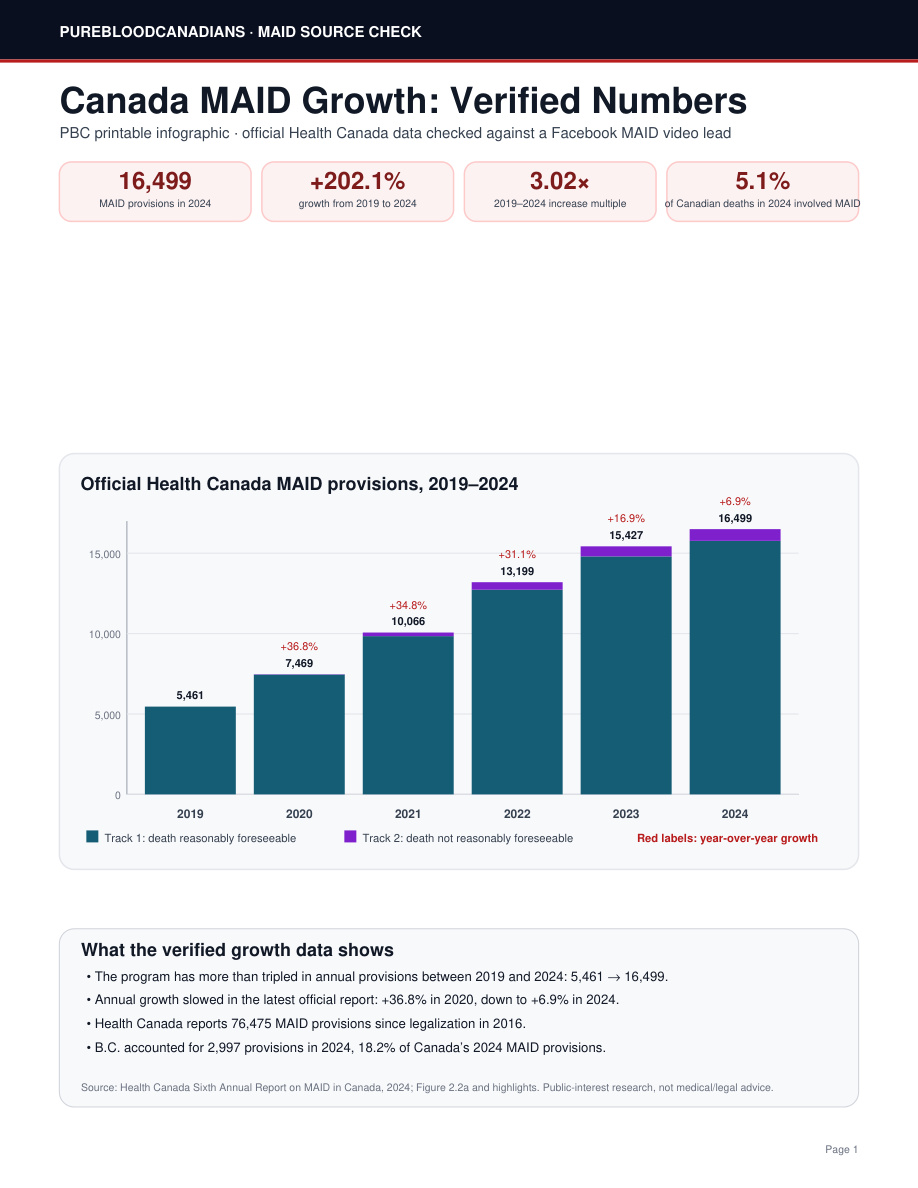
Canada’s medical assistance in dying program has grown from 5,461 MAID provisions in 2019 to 16,499 in 2024, according to Health Canada’s latest annual report.
That is an increase of 11,038 provisions, or 202.1 per cent, over five years. Put another way, the annual number of MAID provisions is now about 3.02 times the 2019 level.
The growth rate has slowed sharply — from 36.8 per cent in 2020 to 6.9 per cent in 2024 — but the total has continued to rise.
What Health Canada’s official numbers show
Health Canada’s Sixth Annual Report says there have been 76,475 MAID provisions in Canada since legalization in 2016. In 2024, MAID was provided to 16,499 people, and Health Canada says that represented 5.1 per cent of people who died in Canada that year.
British Columbia accounted for 2,997 MAID provisions in 2024, or 18.2 per cent of the national total. Health Canada says Quebec, Ontario and B.C. together accounted for nearly 85 per cent of all MAID provisions.
Most 2024 MAID cases were Track 1 cases, meaning the person’s natural death was considered reasonably foreseeable. Health Canada reported 15,767 Track 1 cases and 732 Track 2 cases in 2024.
| Year | Track 1 | Track 2 | Total | Annual growth |
|---|---|---|---|---|
| 2019 | 5,461 | 0 | 5,461 | — |
| 2020 | 7,451 | 18 | 7,469 | +36.8% |
| 2021 | 9,842 | 224 | 10,066 | +34.8% |
| 2022 | 12,730 | 469 | 13,199 | +31.1% |
| 2023 | 14,802 | 625 | 15,427 | +16.9% |
| 2024 | 15,767 | 732 | 16,499 | +6.9% |
What the Facebook video gets right — and where it overreaches
The Facebook video features a discussion about MAID, veterans, medical protocols and the moral language surrounding assisted death. The strongest part of the video is the concern that Canada’s MAID program has expanded quickly. The official statistics support that basic concern.
But the video also makes a much heavier claim: that Canadian MAID recipients are being chemically “waterboarded” or drowned. The evidence reviewed for this article does not prove that claim for Canadian MAID.
The pulmonary-edema evidence cited in the discussion comes from U.S. lethal-injection execution reporting, including NPR’s review of more than 200 inmate autopsies. That evidence raises a serious procedural and ethical question, but it is not the same as Canadian MAID autopsy evidence.
Canadian MAID medication sources reviewed for the PDF commonly identify midazolam, propofol and rocuronium as widely used medications. CAMAP’s Canadian protocol discusses sodium thiopental in a Netherlands protocol context, but the sources reviewed do not show sodium thiopental as the standard Canadian MAID drug.
| Video claim | NewsForBC label | Why |
|---|---|---|
| MAID numbers rose sharply from 2021 to 2022. | Mostly true | Health Canada shows 10,066 in 2021 and 13,199 in 2022, a 31.1% increase. |
| B.C. has a high number of MAID provisions. | True with context | B.C. recorded 2,997 in 2024, 18.2% of Canada’s total. |
| Mental illness-only MAID has been delayed until 2027. | Mostly true | The federal expansion for mental illness as the sole underlying condition is delayed until March 17, 2027. |
| Canadian MAID patients are being “waterboarded to death.” | Not proven by reviewed evidence | The cited pulmonary-edema evidence concerns U.S. executions, not Canadian MAID recipients. |
| Sodium thiopental is the key Canadian MAID drug. | Misleading for Canada | Canadian sources most often point to midazolam, propofol and rocuronium. |
Why this matters for B.C.
B.C. is one of the three provinces that dominate the national MAID numbers. A program that now touches about one in twenty Canadian deaths deserves public audit, clear reporting and careful language.
That means two things can be true at once. The official growth numbers are serious and deserve public attention. At the same time, the most explosive procedure claims should not be repeated as proven unless Canadian evidence directly supports them.
The public question for B.C. is not just whether MAID is legal. It is whether the safeguards are visible, measurable and trusted before the irreversible act takes place.