Rules of the Road · Source Check
Rules of the Road: B.C.’s distracted-driving law is still catching up to modern technology
Kyla Lee’s Reel raises a real legal-modernization issue: B.C.’s electronic-device law is still built on 2009–2010 concepts, while phones, watches and dashboards have changed dramatically.
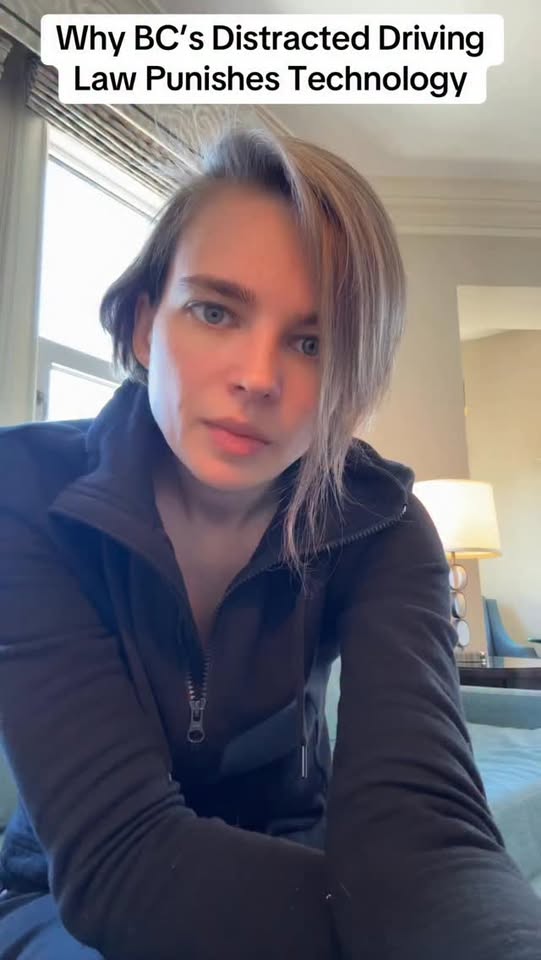
Evidence label: Facebook Reel / legal source-check. This article explains public legal sources and commentary; it is not legal advice.
What the Reel says
Vancouver lawyer Kyla Lee argues that B.C.’s distracted-driving law is “not punishing dangerous conduct” but “punishing technology.” Her main point is that B.C.’s electronic-device law was implemented in 2010 and drafted in 2009, while modern phones, vehicle mode, smartwatches, Bluetooth and built-in vehicle screens have changed how people interact with technology.
The video’s sharpest example is the smartwatch problem: if a wrist-worn smartwatch is not treated the same way as a hand-held phone, the law may produce awkward outcomes where one device is punished differently from another even if both can display calls or messages.
The history: why 2010 matters
B.C.’s core distracted-driving/electronic-device regime dates from the late-2009 regulation and 2010 implementation era. That was the BlackBerry/iPhone early-smartphone moment, before today’s Apple Watch, Android Auto, CarPlay, vehicle-mode lockouts, always-connected dashboards and common wearable messaging.
That history supports part of Lee’s criticism: the law was built around a world where “hand-held” phones were the obvious problem. The technology ecosystem has since moved faster than the statute’s original framing.
Current status: what the law actually says
Motor Vehicle Act Part 3.1 is still current on B.C. Laws. Section 214.1 defines an “electronic device” to include hand-held cellular phones, other hand-held devices with telephone functions, hand-held devices capable of e-mail or text messages, and prescribed devices. It defines “use” to include holding the device where it may be used, operating its functions, communicating through it, or taking other regulated actions.
Section 214.2 says a person must not use an electronic device while driving or operating a motor vehicle on a highway. It also specifically bars communicating by e-mail or other text-based message.
The Use of Electronic Devices While Driving Regulation adds more detail. It says watching the screen is “use.” It also prescribes categories such as hands-free telephone devices, GPS devices, hand-held computing devices, hand-held audio players, hand microphones and televisions. It sets out hands-free/GPS conditions and special limits for Class 7 and 7L drivers.
Current penalties and public guidance
ICBC and police messaging continue to treat distracted driving as a major road-safety issue. ICBC says B.C. could save roughly 80 lives a year if everyone avoided distractions while driving. RCMP guidance tells drivers to leave phones alone, keep eyes on the road and hands on the wheel, and turn phones off or put them out of reach.
Current public penalty messaging identifies a $368 fine and four driver penalty points for electronic-device offences. Separate “drive without due care” can carry $368 and six points. Drivers can also face insurance/driver-risk premium consequences depending on record and repeat behaviour.
Where the technology criticism is fair
The criticism is fair in one important sense: court and legal commentary show the law has needed repeated interpretation around edge cases.
Legal commentary on R. v. Bleau says passive Bluetooth playback from a phone in a cup holder was not “use” where the driver was not actively touching, holding or operating the device. Kyla Lee’s own case roundup describes other hard lines: a phone resting on a lap, earbuds plugged into a phone, a device mounted on a dashboard, a phone on a steering wheel, and an Apple Watch scenario.
That is exactly what happens when a broad law meets fast-changing technology. The courtroom has to decide what counts as “holding,” “operating,” “watching,” “communicating,” or simply having a device present.
Where the Reel overstates it
The claim that the law is “not about keeping people safe” is commentary, not a fact NewsForBC can verify. The official purpose and public messaging are road safety: reducing driver distraction, collisions and injuries. The existence of awkward technology edge cases does not prove the law has no safety purpose.
A more defensible wording is this: B.C.’s distracted-driving law has a real road-safety purpose, but parts of it were designed around 2009-era technology and can produce uneven results when applied to smartwatches, dashboards, Bluetooth and modern phone automation.
Practical Rules of the Road takeaway
Do not treat the smartwatch discussion as permission to text while driving. The safe rule is simple: before moving, set navigation and audio, turn on driving focus/vehicle mode, put the phone away, and avoid interacting with watches, screens or messages until safely parked.
If you receive a ticket, the exact facts matter: what device it was, where it was, whether it was hand-held, whether you touched it, whether the screen was watched, whether the vehicle was safely parked, and what licence class you hold.
Source trail
- Facebook Reel source
- Exact YouTube copy with transcript
- Motor Vehicle Act, Part 3.1
- Use of Electronic Devices While Driving Regulation
- RoadSafetyBC electronic-device guidance
- ICBC distracted-driving page
- B.C. RCMP distracted-driving legislation guide
- DriveSmartBC summary of R. v. Bleau
- Kyla Lee case roundup
- NewsForBC source note and transcript package