Editorial note: This article is a public-record investigation and opinionated accountability analysis. It identifies unanswered questions and possible conflict pathways. It does not assert that any named person, company, Nation, developer, lender or political party has acted unlawfully unless a source says so.
Dallas Brodie’s allegation
OneBC leader Dallas Brodie has called for an investigation into what she describes as a taxpayer-funded bailout for Lower Mainland developers. In a June 28 post, Brodie wrote:
“Something smells here. At a time when the BC and federal Canadian governments are running massive deficits, they are choosing to bail out Lower Mainland developers to the tune of $3.2 Billion. This is a completely unethical use of taxpayer money and an expense we cannot afford.
That is why I am calling for a provincial investigation to be launched to find out who is receiving this taxpayer money and what connections they may have to David Eby, his Ministers, and the BC NDP political party.”
Petition link: OneBC is collecting signatures at 1bc.ca/petitions/condobailout.
The first problem: government announced the rescue before showing the books
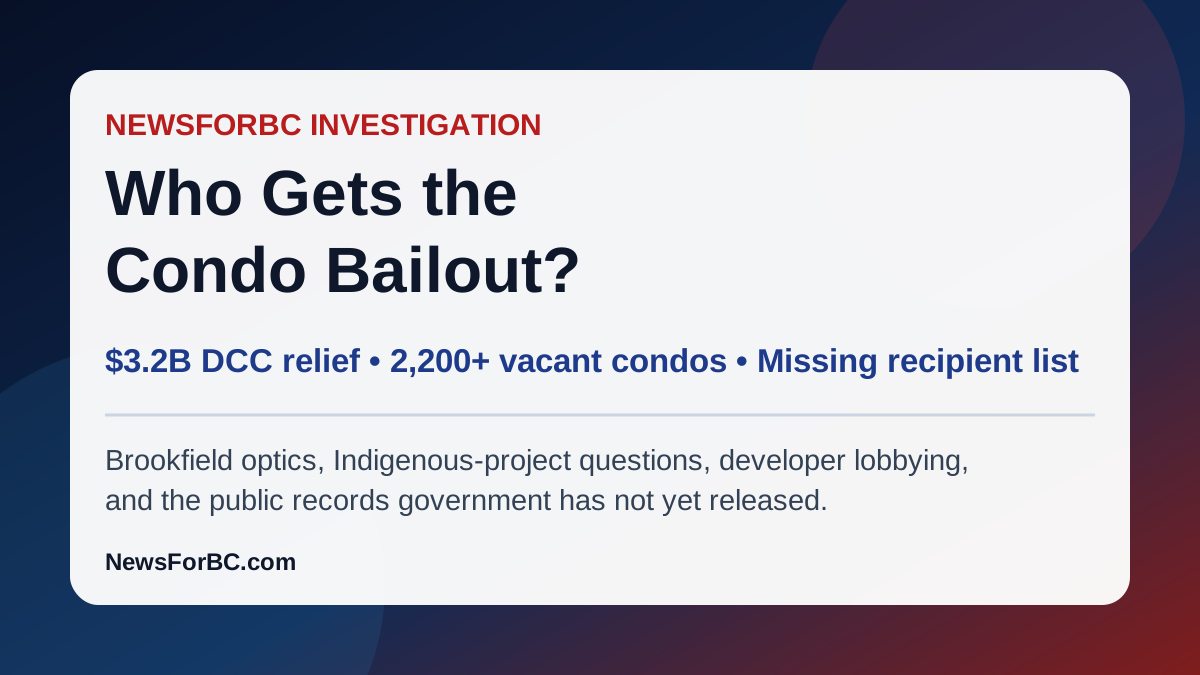
The official June 18 announcement says Ottawa will put nearly $1.6 billion over 10 years into B.C. through the Build Communities Strong Fund, with B.C. matching it for a total up to $3.2 billion. The stated purpose is to lower development charges for multi-unit housing by up to 50 per cent in priority communities, saving up to $40,000 per unit, while funding water, wastewater and local-road infrastructure.
Separately, the federal and provincial governments announced a Canada–B.C. condo-conversion partnership through Build Canada Homes and BC Housing to convert more than 2,200 vacant condo units into affordable homes.
Those two policies are related politically, but they are not the same cheque. That distinction matters. The $3.2 billion is the development-charge/infrastructure envelope. The condo-conversion idea has since been discussed in reporting as a financing structure around $1.45 billion, with details still unfinished.
But the public should not be soothed by accounting categories. Both policies point in the same direction: senior governments are stepping into a real-estate market where developers, lenders and municipalities are under pressure — and the public still does not know which private balance sheets will be protected.
What is confirmed
- The $3.2B envelope is real: federal and provincial money is intended to reduce development charges and fund growth-related infrastructure.
- The 2,200+ condo plan is real: the official release says Build Canada Homes and BC Housing will use financing tools to convert vacant condo units into affordable homes.
- The recipient list is not public: reviewed official materials do not name developers, projects, lenders, buildings or purchase prices.
- Metro Vancouver’s condo overhang is real: CMHC figures cited by Daily Hive and The Tyee show 4,376 completed but unabsorbed condo apartments in the Vancouver census metropolitan area in May 2026, up sharply from a year earlier.
- Industry lobbying pressure is visible: UDI publicly says it and its members raised concerns about Metro Vancouver DCC increases and worked with senior governments and Metro Vancouver to mitigate them.
The missing list: which developers are being saved from price discovery?
This is the question government cannot be allowed to dodge. If the state buys or finances empty private-market condos, the public must know:
- the building name and civic address;
- the developer, seller and beneficial owner;
- the lender and construction financier;
- the number of units acquired;
- the unit mix and square footage;
- the appraised value, market value and purchase price;
- the discount to market and discount to construction cost;
- the strata fees and long-term operating costs;
- the affordability covenant and who enforces it;
- whether any political donor, lobbyist, former staffer or insider is attached to the project.
Without that list, the public cannot tell whether this is housing policy or a quiet balance-sheet operation for politically connected real estate.
Why the development-charge side may be the bigger bailout
The condo-buyout headlines are explosive, but the development-charge relief may be the more durable subsidy. DCCs are meant to help growth pay for growth — water, sewer, roads and infrastructure that new development requires. If senior governments use general taxpayer money to reduce or backfill those charges, the burden shifts away from development economics and onto the broader public.
Business in Vancouver reported that Metro Vancouver had already slashed DCCs by $387 million over three years, and that its board wrote to senior governments asking to recover those costs. The same reporting said it remained unclear whether the new federal/provincial funding would directly compensate Metro Vancouver. Metro Vancouver chair Mike Hurley’s warning — “the devil will be in the details” — is exactly right.
The hidden question is not just “who sells condos?” It is also: which projects get cheaper infrastructure charges, and are buyers or renters guaranteed to see the savings?
Brookfield: not proven, but impossible to ignore
There is no public recipient list showing Brookfield receiving money under this program. NewsForBC has not found a source proving Brookfield-owned units are being purchased or Brookfield projects are selected.
But Brookfield cannot simply be waved away either. Prime Minister Mark Carney’s history with Brookfield Asset Management is a public political fact. Brookfield is a major real-estate and infrastructure player. The program involves infrastructure, housing finance and potentially the absorption of distressed real-estate inventory. That combination demands a conflict screen visible to the public, not just private assurances.
The questions are straightforward:
- Did Brookfield, Brookfield Residential, Brookfield Properties or affiliates have meetings about this program?
- Are any eligible projects owned, financed, partnered, insured or managed by Brookfield-linked entities?
- Did Carney recuse from any decision where Brookfield could benefit?
- Will conflict-of-interest screens be published before any project is selected?
If the answer is “nothing to see here,” government should have no problem showing the records.
Indigenous projects: another question government must answer clearly
Social media has repeatedly dragged Indigenous projects — especially Sen̓áḵw — into the debate. The evidence reviewed so far does not show that Sen̓áḵw is part of the condo-buyout program. Sen̓áḵw is marketed as a Squamish Nation-led, purpose-built rental community, not an unsold strata-condo inventory problem.
That does not make the question illegitimate. Indigenous-led projects, reserve-land partnerships, pension-fund partners, former private partners and federal financing all exist in the broader housing ecosystem. Sen̓áḵw itself has had a separate public financing and ownership history, including Westbank’s former role and later sale of its stake to OPTrust in phases one and two, according to CBC and Daily Hive reporting.
Therefore the government should answer, in writing:
- Are Indigenous-led projects eligible for the 2,200-unit conversion program?
- Are reserve-land projects eligible?
- Are purpose-built rental projects eligible, or only completed vacant strata condos?
- Are projects with previous federal loans eligible?
- Are Sen̓áḵw, Squamish Nation entities, OPTrust or former Westbank-linked structures in or out?
The public does not need rumours. It needs eligibility rules and a list.
The likely private winners if disclosure stays weak
Until the list is released, every name is a candidate, not a confirmed beneficiary. But the likely universe is not mysterious: developers and lenders exposed to completed, unabsorbed condos in the areas with the largest overhang. Public reporting points to Burnaby, Richmond and Coquitlam/Port Moody as key concentrations, with concrete high-rises accounting for much of the unsold inventory.
The major firms and project ecosystems that should be watched include, without alleging receipt: Concord Pacific, Onni, Polygon, Bosa, Westbank, Wesgroup, Anthem, Beedie, Aquilini, Keltic, Ledingham McAllister, Intracorp, Townline, PCI and others active in Metro Vancouver high-rise development.
Government should not wait for opposition researchers to guess. It should publish the eligibility and procurement pipeline before any deal closes.
What should be investigated
- Recipient disclosure: every project, developer, seller, owner, lender, unit count and price.
- DCC pass-through: whether public development-charge relief lowers home prices/rents or simply restores developer margins.
- Lobbying records: meetings with UDI, Homebuilders Association Vancouver, major developers, Metro Vancouver, BC Housing, CMHC, Build Canada Homes, PMO and B.C. Housing Ministry.
- Conflict screens: Brookfield, former political staff, donors, consultants and ministerial connections.
- Indigenous-project eligibility: clear inclusion/exclusion rules for Nation-led, reserve-land and previously federally financed projects.
- Affordability permanence: whether units become permanently affordable public/non-profit/co-op housing or temporary subsidized inventory.
- Value for money: independent appraisal, discount-to-market and discount-to-construction-cost on every unit.
The scathing but fair conclusion
If the governments are buying distressed condos below replacement cost and locking them into permanent affordability, they can prove it. If developers are truly taking losses, publish the numbers. If no Brookfield-linked entity can benefit, publish the conflict screen. If Indigenous projects are not involved, publish the eligibility rules. If DCC relief will be passed through to renters and buyers, publish the enforcement mechanism.
Until then, the suspicion is not paranoia. It is a normal democratic response to a multibillion-dollar announcement with no recipient list, no project list, no price list and no conflict file.
The issue is not whether B.C. needs housing. It does. The issue is whether a housing crisis is being used to launder private development risk through the public treasury while calling it affordability.
That is why the public inquiry demand has traction — and why government should release the records before the first cheque, financing instrument or DCC backfill is allowed to disappear into the fog.