
Saturday Feature · Opinion and analysis
Alberta’s Referendum Is No Blank Cheque for Ottawa—or Separation
Monday’s Alberta referendum calls for an honest reading of the ballot—and measurable accountability from Ottawa and the province.
By NewsForBC Editorial Desk ·
Canadians should not have to choose between taking Alberta’s grievances seriously and keeping the country together. Monday’s referendum demands something better than that false choice: an honest account of what voters are deciding, followed by measurable answers from both governments.
What the ballot actually asks
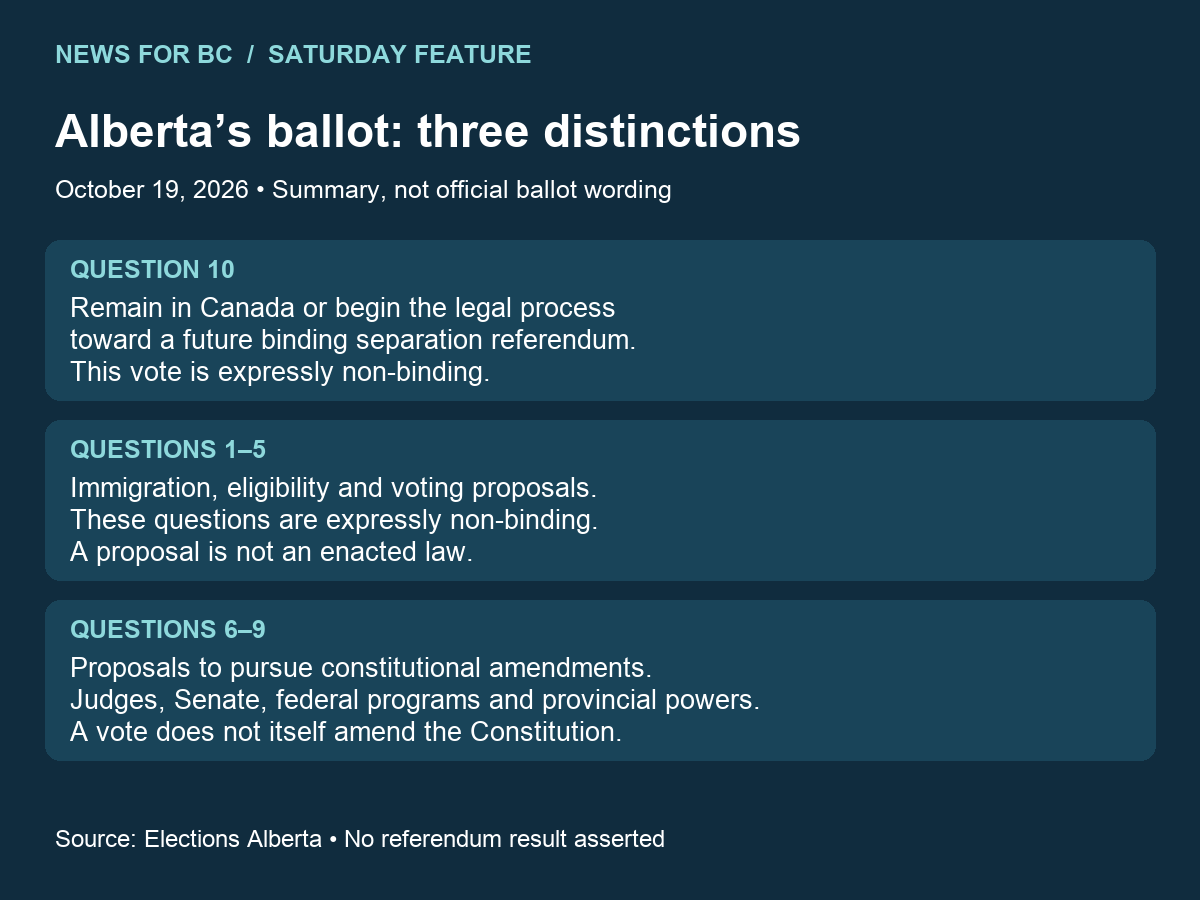
The first correction is important. Question 10 does not itself take Alberta out of Canada. Elections Alberta describes a non-binding choice between remaining a province and having the provincial government commence the constitutional legal process toward a future binding separation referendum. A dramatic campaign slogan is not a substitute for the ballot’s actual wording. [1]
Prime Minister Mark Carney went to Calgary this week urging Albertans to remain in Canada and reject the other nine questions. Premier Danielle Smith also advocates remaining, according to BBC reporting, but wants support for the nine proposals concerning immigration and constitutional change. This is not simply one leader for Canada and another against it. [3] [4]
Those other questions deserve their own scrutiny. Elections Alberta explicitly identifies the five immigration-related questions as non-binding. Four further questions seek constitutional changes involving judicial appointments, the Senate, federal programs and provincial powers. Voting on proposals to pursue amendments is not the same thing as having those amendments already in force. [1]
Unity must come with accountability
For a tradesperson, small-business owner or family trying to secure healthcare, the useful question is what improves after the campaign signs come down. Ottawa should answer resource-development and service-capacity concerns with specific commitments, responsible ministers and public deadlines—not treat a remain vote as approval of every federal policy. Alberta’s government should explain the costs, legal steps and practical benefits of its own proposals just as plainly.
The strongest unity argument is that Canadians can improve their federation without accepting the uncertainty of a separation process. Its weakness would be assuming that a favourable result settles the grievances that produced this debate.
Keep Canada together; take provincial accountability seriously; make both governments show their work. Workers and families deserve more than another round of symbolic victories.
Read each question on its own merits
Federalists can reasonably prioritize a decisive remain result; supporters of greater autonomy argue that a strong mandate is needed to get Ottawa’s attention. Neither argument removes the need to assess the other questions separately. A remain vote is not a verdict on every federal policy, and a yes vote on a proposal does not establish that it will be lawful, affordable or effective.
For B.C. readers, the useful test is the same one: separate political promises from the authority actually being requested. Any detailed claim about constitutional implementation needs analysis beyond a campaign slogan.
Sources and evidence limits
- Elections Alberta—referendum questions — Primary ballot wording and Orders in Council. Explicit non-binding status for Question 10 and Questions 1–5; wording of constitutional Questions 6–9. Full page independently retrieved.
- Elections Alberta—current voting information — October 19 voting day; advance voting through October 17; preliminary counting arrangements; official results scheduled for October 29.
- Canadian Press/Calgary Journal, October 15 — Carney’s Calgary appearances and opposition to the other nine proposals; Smith’s provincial-autonomy position.
- BBC, October 16 — Thursday’s unity rally, Smith’s support for remaining, and competing campaign arguments. Crowd, turnout and economic-loss estimates are not needed for this feature.
Sources refreshed October 17, 2026. No interviews or outreach were conducted for this editorial. Source and methods note.
Read the companion Saturday feature · More politics coverage